What Each Generation Really Thinks About HR
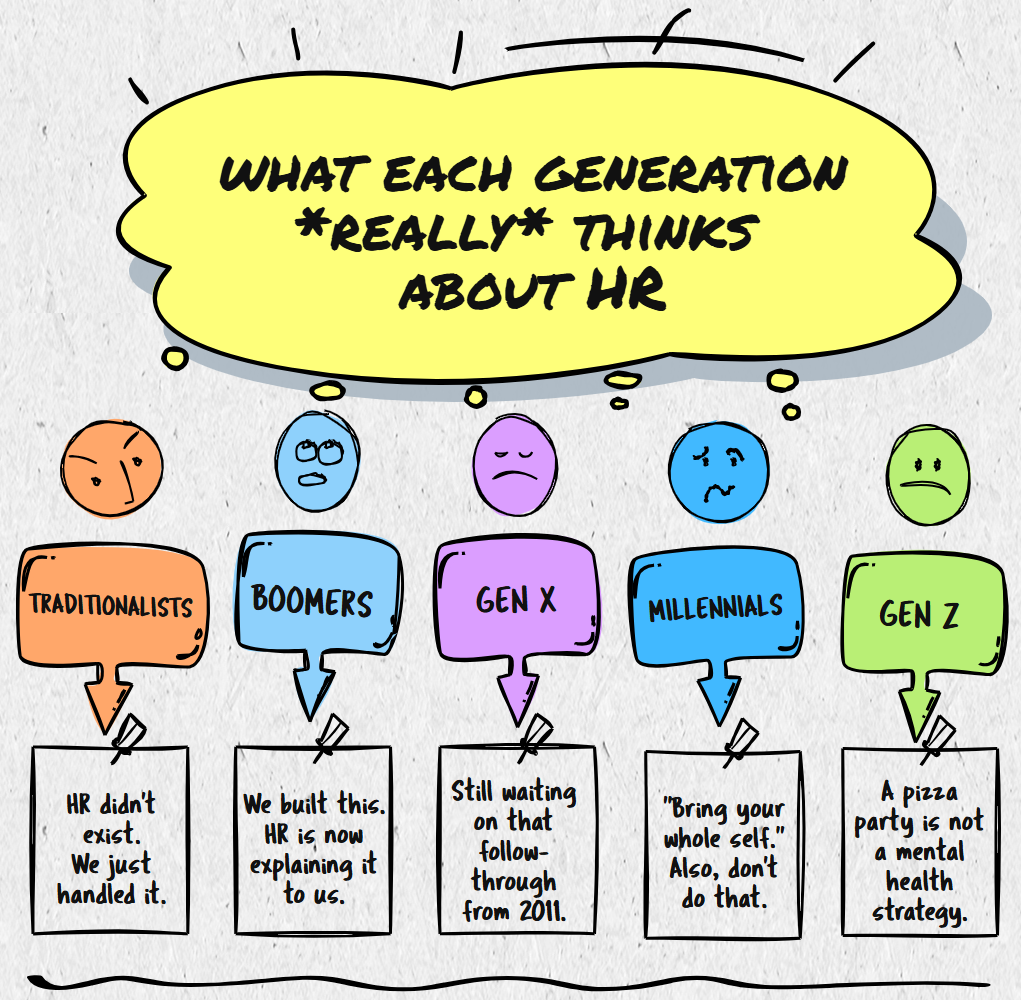
Ask five people from five different generations what they think of HR, and you will get five completely different answers. Not because HR is inconsistent. Because each generation arrived at the function through a different door.
The punchlines are funny. What's underneath them is more interesting.
Traditionalists predate HR as a formal function. Work ran on authority, loyalty, and unspoken rules. There was no department to go to because going somewhere for help was not how the system worked. Problems were absorbed, managed privately, or escalated through hierarchy. The idea that an organization would employ someone specifically to support the employee experience was simply not part of the framework.
Boomers built HR into what it is today. They professionalized the function, created policies, and pushed for consistency. They also carry the most layered relationship with it, because the institution they helped build has changed faster than the culture around it. The Boomer view of HR often runs through the lens of what it was supposed to be, measured against what it became.
Gen X entered a workforce where HR was formalizing and watched a lot of promises go sideways during downsizing, restructuring, and corporate culture shifts. The skepticism is earned, not inherited. Gen X did not decide to distrust institutions. They watched institutions give them reasons to.
Millennials pushed HR to expand its definition of a healthy workplace. The asks were genuine and, in many ways, ahead of their time. Psychological safety, transparent feedback, purpose-driven work, whole-person leadership. These were not soft ideas. The execution has been uneven, and Millennials have felt that gap directly.
Gen Z arrived already fluent in the language of mental health and institutional accountability. They are not cynical the way Gen X is. They are operating from higher expectations and less patience for the distance between what a policy says and what the culture actually does. That is a different problem, and a useful one, if leaders know how to work with it.
This is exactly what the GenShift® framework is built around. Not generational stereotypes, but generational context. When you understand where each person's relationship with work began, the friction in the room starts to make sense. And once it makes sense, it is a lot easier to move through.
The HR Across Generations series on the GenShift® Podcast goes deeper on all of this. One generation at a time, in their own voice, talking about what it actually feels like to work in HR from where they sit. It is the kind of perspective that is hard to get anywhere else.