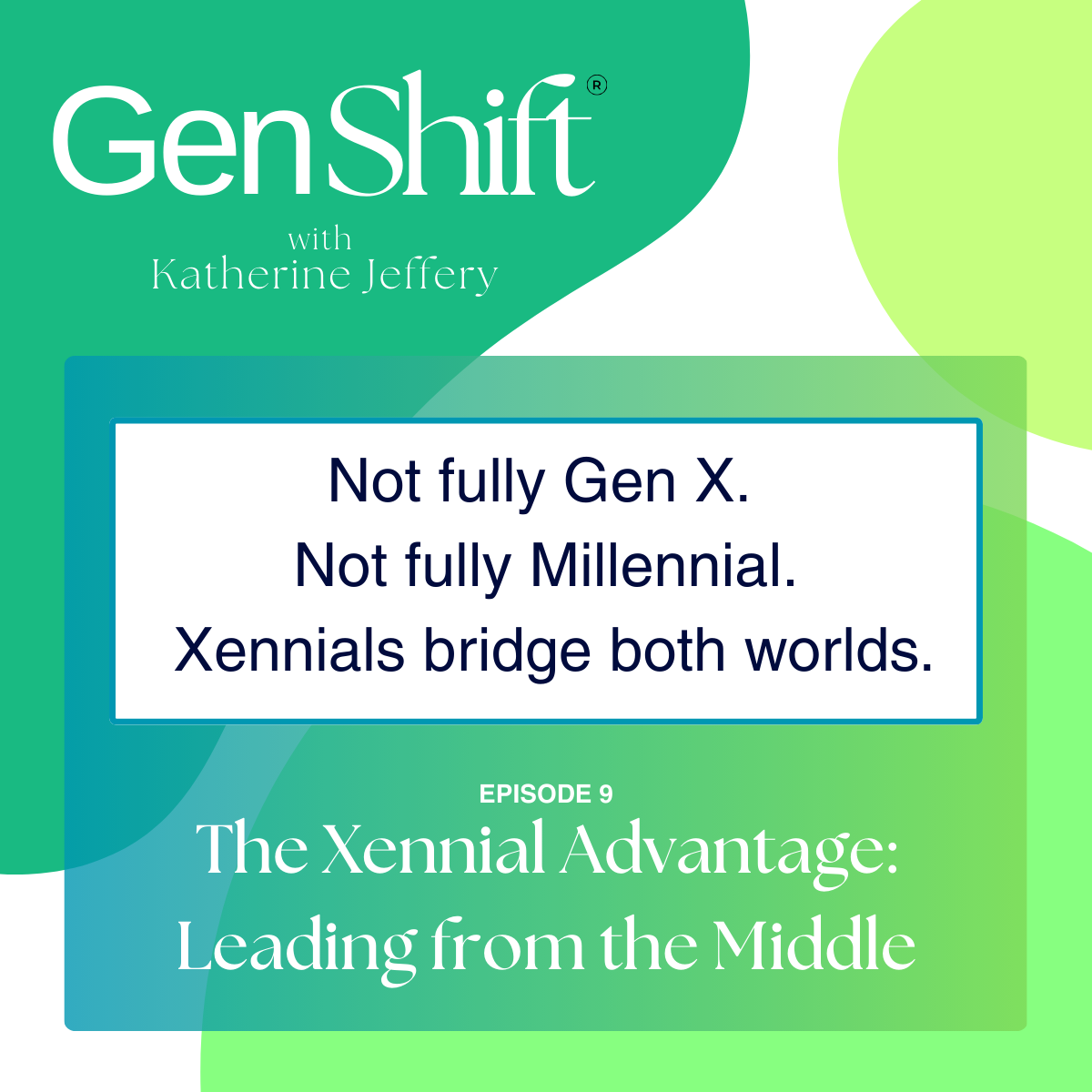
Episode 9: The Xennial Experience — Bridging Two Worlds
Listen
Description
If you’ve ever felt caught between generations, this episode will feel familiar.
Dr. Katherine Jeffery explores the Xennial experience with guests Ben Miner, Jessica Schneider, and Robbie Shaul. Born between Gen X and Millennials, Xennials grew up analog and adapted quickly to a digital world. That in-between perspective shapes how they approach work, change, and leadership today.
This conversation highlights why Xennials often act as natural connectors in the workplace, bridging generations, translating perspectives, and navigating constant change with flexibility and care.
January 5, 2026
Release Date
Guests
Ben Miner
Jessica Schneider
Robbie Shaul
Dr. Katherine Jeffery: Welcome to the GenShift podcast, where we explore how generations shape the way we live, work, and lead. I'm your host, Dr. Katherine Jeffery. If you were born between the late 1970s and the early 1980s, this episode might feel especially personal. You're part of a small, often overlooked group known as the Xennials, and that starts with X ends with enal.
Some people like to say X enal to emphasize that X, and these are the people that came of age right on the cusp of Generation X and millennials. This tends to be the group in the room where if you ask them if they're millennial, they'll say I'm a Millennial, but I'm not really a Millennial. This cohort grew up with landlines and mix tapes, but started their careers in the age of email and cell phones.
They remember life before the internet, yet they adapted quickly to the digital world. If you are a Xennial, you are the analog to digital translators of modern life. Today we're joined by three awesome guests who live right in that in between space. We'll talk about how Xennials see work, leadership and change, and how that bridge gives them a unique lens on life.
So before we jump into the conversation, let's set the stage.
Xennials were born roughly between 1977 and 1983. Too young to be full Gen Xers and too old to be true Millennials. Sociologists, call them a microgeneration. They might remember dial up tones, film cameras, and calling friends on a house phone.
But by college or early career, they were using AOL Instant Messenger, Napster, and the first flip phones. Culturally, Xennials grew up during a time of major change. The end of the Cold War, the rise of personal computing nine 11 and the early years of social media. Xennials learned to adapt quickly, balancing independence with collaboration and skepticism with optimism in the workplace.
Xennials often bridge two worlds, Gen X, pragmatism, and Millennial purpose. They value hard work, but they also want balance. They remember a time before constant connectivity, but now navigate that connectivity daily. This dual perspective often makes them natural translators, people who can help multiple generations communicate and collaborate.
Dr. Katherine Jeffery: So I'm super excited about today's guest. We have Ben Miner, Jess Schneider, and Robby Shaul. And each of you represent that Xennial blend of analog roots and digital fluency.
So could you all just tell us a little bit about who you are and what you do?
Jessica Schneider: Hi everyone. I'm Jeff Schneider. I am Senior Director of People Operations at Purpose Brands, which is the parent company for Anytime Fitness, orange Theory Fitness, Basecamp Fitness, Stronger You, Bar Method, and Waxing the City.
I've been with the organization for 16 years and I've had a few different roles. I always say like each prepared me for the next, but doing what I love doing wellbeing and caring for people and making sure that they are in a good spot personally and professionally so that they can take care of our franchisees because our franchisees are taking care of all these different members that we have across the world.
Outside of work, I'm a soccer mom. I'm a dog mom. I love being active, getting outside, not wanting zero degrees out. But anything that is just involved my family and travel and new adventures.
Dr. Katherine Jeffery: Awesome. Glad you're here, Jess.
Jessica Schneider: Me too.
Ben Miner: Hey there. I'm Ben Miner from Indianapolis, Indiana. I work for Extremity Solutions.
I'm a senior territory manager. I've been with the company for 16 years. We distribute medical devices Aed, Osteo Med AM surgical, oxygen bio composites, checkpoint, Bio Poly, and the list goes on. I've really enjoyed being in this role watching this company grow over the years. When I'm not working, which is often I'm married and have two little kids. I got started a little bit later. I've got a five-year-old daughter and a two and a half year old son. We are just getting into the afterschool curricular activities with ballet as our first one new territory for me.
And my son is interested in whipping me as if he's spidey all day long. I spend most of my off hours chasing the two of them around.
Dr. Katherine Jeffery: Awesome. That's a fun stage.
Robbie Shaul: Hi everyone. I'm Robbie Shaw. I'm president of PMMC. We're based in Charlotte, North Carolina. We work with hospitals to help them manage their relationship with insurance companies, make sure they're paid correctly, help 'em negotiate better and really leverage their data to improve their finances.
I've been with the organization for 15 years. Done many different roles in the organization and it's been a lot of fun to see us grow over the years. Outside of work. Similar to Ben got a five-year-old daughter that's in dance which is fun. A golf simulator store opened next door, so I drop her off at dance and I go hit some golf balls and I have about 30 minutes to do that.
So it started working out perfect for me. It hasn't helped my golf game, but it gives me something to do. But outside of driving her around and doing that. We do a lot of tennis and golf and just try and be outside as much as possible.
Dr. Katherine Jeffery: Excellent. That was a smart business move.
Whoever opened up that golf simulation.
Robbie Shaul: It's a shameless plug for my neighbor's business.
Dr. Katherine Jeffery: No kidding. Alright. I hope everybody hears, like they've all been at their companies for 15 plus years, so that's really significant. And says something about this micro generation. Now, you each grew up watching technology basically transform overnight.
So how has that shaped the way you actually handle change, either at work or in your personal life?
Ben Miner: I can talk about myself at work. I have zero control over my schedule throughout the day. I'm at the whim of when a surgery's gonna start. And that has tons of factors. So I've had to be very malleable with, time management. And I think that as we grew up going from, I remember the TV in my parents' kitchen, having the dial to, turn into the couple black and white channels that you could get to now I get called, Hey, the home security system doesn't work, or, the wifi is not working for my parents and my sister.
So now, I've had to evolve and become more of a, the tech support, if you will. I think that as that has changed, it allows us to say, Hey, let's roll with this. Let's be malleable. Let's adapt. For what I do it becomes really kinda like my superpower, if you will.
I think I see a lot of others get bogged down because things aren't going on time and I just roll with it. And I think that's part of how we grew up. Things changed all the time. So that's one perspective we bring.
Dr. Katherine Jeffery: I love that.
Jessica Schneider: I'll bring a totally, somewhat different perspective to it, whereas like I can appreciate technology and where we've come from.
I remember having a cell phone in a box in my car when I started driving right. To where we are now. And I think that work life balance is so important to me and not being so consumed with always being on or looking at a screen. I wanna just disconnect because that's how I recharge and everything.
That while I appreciate technology and what it does and how it helps in certain ways, I still put a little bit of a roadblock up of how much I get involved with it. Like when I get home, the last thing I wanna do is be on my phone or anything like that. So I'm like putting it away or like first thing in the morning, I'm super protective of that time in the morning.
I don't wanna be getting messages from people at work until I'm ready. So I just don't even look at it because then I get annoyed and I'm like, Ugh, it's too early for you to be messaging me. Just give me my space. Let me get into my day. And at night and I wanna be super protective of my teams time at night.
So if I am working late, I'll use delay delivery on my emails a ton so that I feel like I got my stuff done, but they're not getting it until the next morning during the day. So I appreciate it, but still I'm not out there trying to learn, how to use the newest technology or installing the newest app on my phone or things like that, just because I'd rather be outside and, doing things than being on technology.
Dr. Katherine Jeffery: Yeah. And Jess, I just wanna highlight what you said about the delay send. That comes up a lot. Yeah. Do your younger employees that you work with, do they appreciate that about you?
Jessica Schneider: I don't, I've never shared with them that I use it.
Dr. Katherine Jeffery: Okay.
Jessica Schneider: I wanna be respectful of their time at home.
And so I don't want them to feel that if they know I'm working at night or past, but I have a crazy schedule. Like I might leave work to take my kids to soccer practice or basketball, and I sit in my car from, five 30 until seven or whatever, and I'm on my computer and I'm working.
I don't want them to feel that way, that they need to be checking things. And so I just keep it to myself and get my work done and do my thing. And, if I need them, I will. But I really try to respect that boundary because I want people to respect that boundary for me.
Dr. Katherine Jeffery: Yep. That's really good.
I think it's important for people to hear that, 'cause that's a big discussion in the workplace, so thank you. Robbie, any thoughts?
Robbie Shaul: I bet your team has figured out that you use delayed send because 15 emails at 8:00 AM
Jessica Schneider: Exactly at 8:00 AM Okay, so now I'm gonna start doing like 8 0 5, 8 0 7.
Thanks Robbie.
Robbie Shaul: People used to know when I got off a plane because as soon as I hooked up the wifi. Emails would go out immediately but for me, similar to Jess, I live that kind of two separate lives. I have my work life and then I have the personal life. In my work life, I'm very technology forward.
We're a software company. We have to be focused on utilizing what's new, what's out there trying different things. And we've piloted blockchain opportunities and done a few different things with kind of more advanced tech and so anything that makes us smarter, faster, better, we've gotta be all in on and really try and figure out how to use it, how to leverage it and at the same time how to protect our own data.
So the professional life of yes, new technology. The personal side of me is stay the freak away from me. We have TVs, but like beyond that, I'm not downloading new apps. I'm not putting anything on my personal devices. Very protective of how we use technology.
Not necessarily at home. 'Cause my wife does her own thing. She's much more of a millennial than I am. But I don't wanna be burdened with technology at home. I don't have any interest in improving my personal life of, this new app can do this for you. Or using Instacart to do my grocery shopping.
I don't want any of that. But that's also more the finance guy of me. Instacart, overcharges they just got caught doing surge pricing and dynamic pricing. So that's more the finance side of me and not wanting to be overcharged for different things.
So I feel like I have two lives when it comes to technology.
Dr. Katherine Jeffery: So question for all of you. Like when you hear that term Xennial, what comes to mind for you? And do you actually identify with that label or does it feel made up?
Jessica Schneider: I'll go. I feel special. I'm like, all right, this is cool. I'm part of two groups and for me, I'm very welcoming. I want everybody to be part of something. I don't know if it's like partly being Italian or whatnot, but I want everybody like to come to the table and be part of that.
So for me, I'm like, all right, I can relate to two different groups of people and really have like extra skills to be able to relate and communicate and just feel very well-rounded. Excellent.
Ben Miner: I had never heard of the term until you came and spoke with our team here in Indy. When people would ask what generation I was in, I could never really put a finger on it because I didn't feel like a millennial and I never really felt like a Gen X until I had been educated what that meant, I had no clue. I just thought we were just in this lost zone.
Dr. Katherine Jeffery: So did you feel home when you learned about it?
Ben Miner: Yeah. It's nice to be able to put a name to it, right? Put a pin on it.
Dr. Katherine Jeffery: Yeah.
Robbie Shaul : I'd probably use that same term of lost.
I hadn't heard of it either. I still feel lost. But I'm also on the younger end. But I'm still feeling that kind of mix of all my friends.
I've got two separate friend groups. We don't mix.
So it's interesting to learn about why we think different ways than other people and how to really bridge that gap. Lost was the probably right term. I don't know if I found myself yet though.
Dr. Katherine Jeffery: What do you the three of you think the world could learn from your generations in between perspective?
Jessica Schneider: I would say to keep an open mind, right? Everybody has different perspectives and that's the really the thing that I think about this world and when you meet people. Everybody's perspective is so cool and so unique and what makes 'em who they are that like, if we all just accepted that maybe we'd be a little bit nicer to each other and more open.
I think of the people who say anything on Facebook.
Like we have a neighborhood Facebook group and everybody's will say things on there and I'm like, that's your neighbor. What would you do if you were walking your dog and you saw them? Would you say the same thing to them? And so I think it's, if everybody would just would pause and be like, yeah, let's respect everybody's different perspective on things and who they are as people that, everyone would get along.
I agree.
Ben Miner: I think you're absolutely right there, Jess. Where we are situated makes us that, nice conduit. We can relate to both perspectives of above and below different generations and can see the good in both. And I don't think, there are certain things that I will like, die on certain things that I really hold firm on.
But I've changed a lot of those stances over the years just because of some of the younger kids that we've hired so I think our ability to adapt, roll with things, and evolve, is what makes our micro generation unique in that sense.
Jessica Schneider: I love that you said kids, Ben. I say that too, and I always am like, can I say that?
Coming from HR, I'm like, I probably shouldn't say that.
Dr. Katherine Jeffery: Yeah. Gen Zrs will specifically say, please don't call me kiddo. I'm not a kiddo.
Yeah.
Robbie Shaul: I think the interesting thing is just even as we've grown up and developed in our careers, how much we've changed at the same time, how much we've been influenced by older generations and then also influenced by the younger generations and how they like to do things. And I think that's just more of a natural evolution.
As Millennials grow up and Gen Zers grow up, I honestly think they'll feel a little bit more closer to where we are. As they so to speak, hit the real world and realize we can't just conform to you, we all gotta conform together. I think it is the interesting piece that as people come into the workforce, they start learning and then once they've hit that 5, 10 year mark, it's oh, okay.
I kinda see how we have to interact together and do things different versus when they come in immediately, it's always, why does that generation do things that way? They're always wrong. If they just used X, Y, Z, it'd be done in a minute. And it's just that natural evolution that happens as every new generation comes into the workforce.
Dr. Katherine Jeffery: So well said. I think you just quoted like a hundred people I've heard say like you're so spot on when you say that.
So Gen X is known for independence, while millennials often seek collaboration and purpose, where do you see yourself landing on that spectrum?
Jessica Schneider: I love being handed a project from my boss and being like, Jess, get this done. Heads down, whip it out hand it back to her. But also my cup is so filled when I have a whiteboarding session with my boss we'll go into our training room and we have full walls of whiteboards and we just spend two hours whiteboarding things out planning and being creative and strategizing and working together and knocking ideas off each other. I am so fulfilled after those sessions that, there's this balance, it's let me take what we did now, and now I'm gonna go heads down and I'm gonna knock out these projects and, execute what we need to do.
So I am super in the middle between them both. They kinda go hand in hand.
Dr. Katherine Jeffery: Yep. Yep.
Ben Miner: Yeah, I think I'm probably very similar. I like to have my finger on the pulse or be in control, if you will. But as my career has gone on and my personal life has evolved. There's only so much sand I can hold in my hands at one time.
There's things that I delegate to my associates which makes my life easier. I'm still skeptical and make them, Hey, send me a picture. How, how does that set look? Do you have everything correct? And I have to adapt and get better at kinda letting go.
But I've always had this mindset of, if you gimme the rules get outta my way and I'll win. But that has also been a detriment to me in my personal life because it's just all work and then no balance.
Dr. Katherine Jeffery: That sounds very Gen X of you, Ben.
Ben Miner: Yeah,
Robbie Shaul: So, that's a struggle. When you run a company or have a company, independence isn't a thing that's gonna be a limiting belief.
So you really have to learn to rely on people to do their job and you not do it for them. And with that collaboration and purpose has to come out. And you can't effectively lead people without that kind of collaborative, purpose-driven mentality. At least in today's generations that are working.
It used to be you could rule with an iron fist, tell 'em to do it or else.
But the job market's so fluid, you won't have any people working for you for very long. So I've always streamed more towards the collaboration, the purpose. The best thing I can do for my organization is to hire people smarter than me and get outta the way.
That's really what I try and focus on and do and just trying to fuel the fire and then get outta the way.
Dr. Katherine Jeffery: And Robbie, you said you're a little younger, right? So you're leaning much more to that millennial side.
At least in that Yeah.
In this space, yeah. Yes. Not at all otherwise, yeah, you wouldn't have been a fit for this episode. But you are, you're that old soul.
There's 10 years between me and my siblings, so I grew up with a different mentality than most of my kind of millennial friends are the oldest in their family versus me being the youngest.
Dr. Katherine Jeffery: Yeah, and that's a great point because people ask about that, right? If you have older siblings, sometimes you get pulled in that direction because that's more of the culture that you grew up in, in your home.
So if you all could give advice to leaders from other generations about working with your micro generation, what would you want them to understand about you?
Jessica Schneider: For me it's trust. Trust that I'm going to get the job done and do what I say I am going to do. Like give it to me and then get outta my way and let me do it. 'cause I will deliver on whatever you want me to. But I think trust is the biggest thing for me.
Ben Miner: Yeah. I agree with that, Jess. Trust that I will get the job done and trust that I can handle it at the same time. It's a tough question. I would say even though I'm on the younger side of this Microgeneration I always seem to be more of a Gen X mindset at things a little bit more dogmatic at times.
I think the other thing that I would say is not only just trust me, but also know that like I can adapt, that if I hit a roadblock I will ask for help. I'm not going to just continue to bash my head against the wall to try to force something.
Robbie Shaul: Yeah, it's hard to think through that question. I think the one thing I want most people to realize, or at least recognize with the microgeneration is there's multiple ways to do things, whether it be Millennials looking at Gen X saying, you should do it this way, or Gen X looking at Millennials saying you should do it this way, is there's no real one right way.
That the only right way is to do it and get it done, and who cares how you do it. And I think that's what the Microgeneration represents, is you get a little bit of a different flavor with each individual that's there. Which tendencies they do, they have that go Millennial, which tendencies do they have that go Gen X and you almost have a different person in this generation with, depending on who you talk to.
Ben Miner: Rob, you just said something that made me chuckle. I remember when my daughter was born, I was, how can I say this? Critiquing or trying to help my wife on how to bathe our daughter. And she turned to me and she's just you know what? I do it my way and we have fun and I just step back and say yeah, I do it this way.
At the end of the day, the kids getting clean, it doesn't matter.
Robbie Shaul: Yeah. That's a conversation you need to back out of. Oh yeah, absolutely.
Dr. Katherine Jeffery: Jess, any thoughts on that one?
Jessica Schneider: My husband lives by the happy wife, happy life sort of mentality. But it's funny that you say that because I remember one time I was working, I was getting ready to present at our annual conference and I had this presentation all set and I went and I delivered it to our CEO.
We were smaller at the time, and he looked at me and he was like, Jess. No. Nope. You can do better. And I remember being at the time being like, oh my gosh. And then I was like, okay. And I went back and redid the presentation and it came out better. And so I think that's like also a perspective that we can bring to the table is yes, there's the different perspectives, but what you may hear or what the other person might say may actually make things better.
And in the end, like that's really what matters, right? Like you talked about like hiring smarter teams and hiring smarter people and all of that. And I think that putting out a really good product or a really good project, that's the most important thing. So be open to other suggestions and that sort of thing because in the end you're gonna end up with something better that maybe is more relevant to the time too.
If you're so old school. People may not get with it or understand it, whereas if you have these different generations contributing and telling you things, like it may be more with what's actually happening.
Dr. Katherine Jeffery: Jess, that's a good story 'cause a lot of Gen Xers will say we have really thick skin.
You're not gonna offend us. Just tell us what you're thinking. We'll fix it, we'll get through it. And Millennials are more like, I'd appreciate a compliment sandwich. Tell me if you're doing well, then lace in the constructive criticism, then give me some more, kudos.
And so where do you all fall on that spectrum?
Jessica Schneider: Just tell me. Let's not go back and forth. Tell me what's on your mind. Tell me what you're thinking and let's move forward. Let's get it done. Let's not waste any time. Just be honest with me. That's how I roll. Yeah.
Dr. Katherine Jeffery: Yep. So really direct to the point. Yep.
Jessica Schneider: Yep. Now tell me it was good afterwards. That's right. That's right. Just like afterwards, give me the pat on the back, but during just let's not play games, just tell me what it is.
Dr. Katherine Jeffery: Yep.
Robbie Shaul: Yeah. I'm of the mindset that I can't do anything about it unless you tell me. And so if it's good, if it's bad, if you want more of it, if you want less of it, you just gotta tell me what it is.
And we'll handle it and deal with it. If we're not open, we're not honest with each other, we won't get things done. If we try and dance around the subject, you're only gonna get half of what you want. And that's my mentality when it comes to whether it be positive feedback or constructive feedback.
Put it on the table, let's deal with it. Let's move on.
Ben Miner: I tell my daughter, tell me the truth and I can fix it. And I do the same thing at work. If I know the truth I can make a change and, whatever the truth is, whether I like it or not, it means, I can fix things. But if you're not, if you're being dishonest with me, then we're all in trouble.
Dr. Katherine Jeffery: Yeah, that's good. Often the Xennials lean much more towards Gen X in that way. That's one of the definite Gen X characteristics that I hear from you all. Another thing I hear a lot from the Xennials is that they're often like leading down and managing up, especially to Gen X and Boomer leaders.
You're fluent in newer ways of working, but you also understand the mindset of the generations above you, which you've, you're clearly articulating. So when you think about managing up to Gen X or Boomer leaders, what comes naturally to you and what still might feel a little bit challenging or frustrating to you?
Robbie Shaul: Yeah. I've had to manage up for some time. I no longer have to manage up.
But the understanding that we basically had was speak your mind, let's debate it vigorously. But when the decision is made, you better be on board. And so that's the mentality I had to have. We debate it, but when the decision's made, whether I like it or not, or agree with it or not, I've gotta be on board and I've gotta run in that direction.
That's what I also try and foster on my team, is we can debate it. And I want you to tell me what you think, but ultimately, if you don't convince me this is what we're gonna do and you need to be on board with it.
Ben Miner: I guess what frustrates me with managing up is, decisions are made, knee jerk reaction. Very emotionally driven sometimes without a whole lot of foresight. Not everything, but some things without a lot of foresight. And that's where I'd say the only person I really manage of is Jake.
We have a very good symbiotic relationship where we can both talk each other off of the ledge. I think I use him more as an outlet for my frustrations in the day-to-day. But as far as managing him as our relationship has evolved and roles have changed, it's not so much as him just being like, this is what we're doing all the time, is more like, Hey, what do you think? And I can give him a different perspective where it's more collaborative. I think that bringing that more Millennial side viewpoint brings that like I said, that emotional response like down to earth a little bit makes a little bit more rational.
Dr. Katherine Jeffery: And Jake is a Gen Xer everybody, the definition Yes. Our quintessential Gen Xer.
Jessica Schneider: I think for me, like one of the challenges is if I'm managing up to like our executive team.
There's conversations and decisions that are being made that I don't have insight to, which is totally fine.
Like I shouldn't but if I am giving feedback or proposing something and there's not a why that is given back to me if they're like, Nope, not doing that, or whatever. And it's because they can't necessarily always tell me why. I think that might be a frustration, but I've also just over the years, have just learned how to communicate to manage up and adapt to who I am speaking to and what's important to them.
And so that has really helped me. I think just have clearer conversations and then also just being here for so long building up. And I think that's one of the things I value about my tenure with the company is I have been here for so long. I have seen a lot, I've been engaged with a lot.
And sharing that and having that credibility has really helped. And so I think, and maybe another frustration is I'm thinking about is like when you have a new leader in and doesn't see all of that history that's frustrating. Like, I've been through this and you know that.
So then that's when you have to adapt and be like, this isn't the person bringing in a new perspective. I have to build this trust. Like that sort of thing. So it's just like this cycle. But I don't know. It's fun to communicate with executive leaders and learn from 'em, right?
Like I look at it as like, how do you wanna communicate? How should I tell you what is important to you? So it's just like building your toolbox of how to communicate and get feedback and that sort of thing.
Dr. Katherine Jeffery: Yeah. And really building your own emotional intelligence.
Jessica Schneider: Yeah. Yep.
Ben Miner: Observing what worked for others and then being able to apply it, kind of being humble enough to say I don't have it all figured out. People ahead of me probably, they knew how to do it as well and absorbing those things and learning.
Jessica Schneider: They've had more experience than me yeah. Yeah. I love that.
Dr. Katherine Jeffery: So a lot of times people say younger generations, they don't really care about experience, right?
Because information is right at their fingertips. But it sounds like you all have a respect for wisdom and experience and people that have gone before you.
Ben Miner: Absolutely. I think when you hear someone else going through something that either you're going through or something similar, you can. Maybe not take all of it, but you may take 2% and change your perspective slightly to, affect your actions down the road. And I think that's invaluable.
It's kinda like baby books, right? There's a billion of them. No one's got it figured out. You take a little bit here and there and then have your own.
Robbie Shaul: It's also similar to a lot of the professional networks. You start to realize that every business has the same problem or same problems.
And there's really no new problems out there. Yeah, there's technology problems that we gotta deal with and implementations we gotta deal with. But when you really boil down every problem you encounter, it comes down to process problems or people problems. There's a lot of people that have been through it and dealt with it and come out the other side.
And so developing that network and that respect for others that have been there, done that is, one of those kind of critical things for you to learn from and critical things that's gonna help you propel your future. So you don't make the same mistakes. I've got probably five to six good mentors that I can call them about any problem.
And I guarantee you they will tell me this is how I handled it when it happened to me, and you probably don't want to do that. And this is what I wish I would've done. Or this is what I did and it worked great. And having that resource bank is critical for you to learn fast and get over problems as they come up.
Dr. Katherine Jeffery: So have mentors been important to each of you throughout your career?
Ben Miner: It's fundamentally for me. I wouldn't be where I am if it hadn't been for my mentor, which is Jake. I remember, I met him 17 years ago when I interviewed and I on the car ride back at the end of the day. I said, I think there's a lot you can teach me, not just in, selling orthopedic devices.
And it's true, it's probably the most rewarding or best thing that ever happened to me professionally was meeting him.
Dr. Katherine Jeffery: Awesome. There's your shout out, Jake. Yeah. There you go.
Ben Miner: That's it. No more.
Dr. Katherine Jeffery: That's right. That's all you get.
Jessica Schneider: I was gonna say just back to what we can learn, my team they're younger.
And I have learned just as much from them as I have learned from team members and coworkers who are older and have been there and done that. Like my team brings things to me and I'm like, oh my gosh, how did you do that? You just taught me. And so I really value that so much like I want them being smarter than me in certain areas and doing things because it makes us better as a whole. But I almost look at the younger generations as learning more from them on what's relevant and how we communicate with my employee population, 50% of 'em are Millennials. So I'm gonna learn a lot more from those team members on how to engage with them, what we need, that sort of thing than I probably am going to from like our executive team who, are these older generations.
Dr. Katherine Jeffery: I love that. Jess.
Robbie Shaul: I think the term mentor is no longer really used. And I think that's the shift we've seen. You don't really view them as mentors.
You view them as friends, and it doesn't mean that they're necessarily older than you or younger than you. It's people that have been there, done that, whatever that may be, that can teach you something. For me personally, they all happen to be older than me. But I think that term mentor is going away and it's more of relationships and friendships of people you can lean on and more of a resource network than a mentorship.
Jessica Schneider: Love it. And Robbie, they're probably learning just as much from you. As you are from them. Yeah. I love that.
Robbie Shaul: I don't think anyone's learning from me.
Jessica Schneider: I don't think you'd be in your shoes if they weren't.
Dr. Katherine Jeffery: True statement.
You've probably seen it before. A Gen Z employee suggests new software, but their boomer manager shuts it down with, no, we've always done it this way. Or maybe you've watched a traditionalist roll their eyes when a millennial colleague asks about working remotely. These moments create unproductive tension leading to frustration, dissatisfaction, and stress, but it doesn't have to be that way.
Work. Places don't have to be divided. That's why I created the Gen Shift e-learning course. With over 20 years studying generational differences, I've built over 40 lessons to help bridge the gap in life leadership and work. Enroll today and get 10% off with promo code, podgenshift. Want to go deeper, schedule a free demo or book a workshop with your team to develop practical strategies for intergenerational success, visit katherinejeffery.com/elearning.
To get started, let's build a space where every generation can thrive.
Dr. Katherine Jeffery: So what do you all notice when Gen Zs join your team? Do you feel more aligned with them or do you feel more aligned with the Gen Xers and Boomers or maybe even the Millennials?
Jessica Schneider: For me it's more the Millennials because I want to disrupt, like I want to do things that no one has ever done before, that is unique. If I'm thinking about the employee experience, like I want someone to be like, wow, that was so different and unique that I've never seen that done before.
And so I really think I get more of that disruptiveness mentality from like my millennials that are, part of the company and on my team.
Ben Miner: I'm thinking how to answer this.
This is the cancel question.
Dr. Katherine Jeffery: That's right. They will find you, they'll listen to this.
Ben Miner: To go off what Jess said, so I hired an associate. I've hired a few but the guy that I've hired recently I have probably learned a lot more from him than I thought that I would.
He has this ability to laugh things off, not take things so serious where I wanna buckle down and just get things done. And if things don't go well, it drives me nuts. So I've learned a lot. There are things that the Gen Zs that they hold very important to them, like personal space and balance and these boundaries that are very defined where I didn't have the luxury of doing that when we were getting this company going.
Where, I worked weekend after weekend and get called in five in the morning or two in the morning for you know, saw Blade going through the hand kind of stuff. Where now, the people who are hiring that are younger want to know this is when I'm on and this is when I'm off and don't bother me after this.
We have a family place up in northern Michigan and I'm on a golf course. And back then we had, we carried a pager and I didn't have my pager on me, and next thing you know, I see a golf cart coming up and over the bluffs towards us, and they're like, are you Ben Miner?
I'm like, yeah. They go, we have a Jake Ritter on the phone at the clubhouse because, I didn't have my phone or my pager on me at the time where there was no boundary. And that's like the mentality that I had working, but now it's shifted. I would say that I've gotten better I've had a hard time accepting that.
I remember like going through, sports or in a fraternity and people were saying like we got hazed. You should get hazed too. And. I always hated that. I'm like, be better. Like, why? It doesn't make sense. So I try to take that mentality like, okay, maybe these boundaries are very important.
I think naturally I'd gravitate more towards the older generations, but I'm learning that some of these things are very healthy. I think you get what I'm saying. I realize that I don't know it all and, my way is not the best way.
It's a challenge for me, but I'm getting better.
Dr. Katherine Jeffery: It's a whole different way of operating. Yeah,
Ben Miner: It is.
Jessica Schneider: Ben, you are not alone. I have felt those same feelings.
Dr. Katherine Jeffery: That's good to know. Yeah.
Jessica Schneider: What is that boundary of like you saying this needs to be done and this is a priority without feeling like you're crossing my boundaries and you're a horrible manager. I don't wanna work for you. I'm done. I quit.
That's what goes back and forth between my mind. We gotta get this done. I need you to have the same priority and the same feeling, but don't hate me.
Ben Miner: Oh yeah. It's a constant struggle. I do my best to try to never ask anyone to do something that I, wouldn't do myself or haven't done a hundred times myself.
And then when I have the opportunity to actually do that job that I typically delegate I try to do it so they don't have to. I think that goes a long way. But I know exactly what you're meaning, it's okay, we need to go do this count at a facility that's a pain to get into.
You're gonna do it and I'm not gonna do it. Yeah.
Jessica Schneider: Because you've done it. It have done
Ben Miner: Exactly. And you need to figure out how to do it.
Dr. Katherine Jeffery: How does that go over, Ben?
Ben Miner: I've trained almost everybody that we've hired. And we do a lot. it's a lot of terminology and a lot of stuff that, a lot of us never learned in high school or college.
And what I've learned, and the way I learn is if I tell you an answer, you're gonna forget it. So I try to say look it up. I could be like, what does, osteomyelitis mean? And I'm like if I tell you, you're gonna forget. You need to look it up. And I get the, this looks like, but it's the truth.
I think that there are certain things that you have to hold onto. And I tell 'em like, look, I'm doing this for your own good and you'll thank me later. In our industry and in our company, the ones who accept that, they're like, I'm not doing this to be mean.
And they get I'm trying to help you develop. They're the ones who stuck around the longest. The ones who think that they've got it all figured out, it's pretty hard to make it work here.
Robbie Shaul: I would probably say that about everyone is anyone that thinks they have it figured out, they don't have it figured out.
That kind of constant learning mindset is critical. And when you asked me which generation I navigate to between Gen X or Gen Z or which one I have more alignment with, I would say neither. They. I really align with people that want to learn and wanna come in and learn no matter what it is.
And in some cases that's a Gen X or in some cases that's a Genzer and I navigate more to that personality. Versus anything else. And I think when you talk about people sticking around the longest, then I think that's what you've found is people that wanna learn that want to do well and as long as you find that no matter what generation they come from, they're gonna do well.
Dr. Katherine Jeffery: Yep. So it's matching the mindset. Yeah.
Jessica Schneider: Yeah. So I see, I'm sitting here listening to us and thinking of all three of our backgrounds, and I think all three of us come from this entrepreneur company, right? We've all been there 15, 16 years when the company was just starting out, and it's grown.
And like it takes that special kind of mindset to go through that. And I think that's where I struggle sometimes is I am like, look at what we started with and now you're just coming in and like we did all of this. And so I think that we're also in this unique situation of the company that we work for and the mindset that we had and the work that we've put into it to get it to where it is now and where we are now.
Dr. Katherine Jeffery: So you've had to adapt so much. 'cause you're right. You come in with an entrepreneur mindset, you're wearing all these hats, you have to be kinda scrappy, And then as it grows, people expect more. They're coming into a completely different environment. And you might actually be hiring different types of people.
Because of where the organization is at.
Jessica Schneider: You don't get where we were 15 years ago and what we had to do. And now you just come in and you want this huge salary and benefits and boundaries and all of this. That doesn't fly.
Dr. Katherine Jeffery: That's right. I didn't get that when I started. You sound like a boomer, Jess.
Oh, that's great. Okay. What advice would you give younger employees who need to manage up effectively to a Boomer or Gen Xer?
Jessica Schneider: Be super clear, consistent we, our general counsel always says, what problem are we trying to solve? And so having that mindset when you are communicating and like in person say it to their face or whatnot. But yeah, what problem are you trying to solve and how are you gonna solve it?
Dr. Katherine Jeffery: Yeah. Like bottom line, me . Do it in person. Yep.
Robbie Shaul: Yeah. I would couple that with know your stuff. You can't shoot from the hip. And that drives me bonkers when someone gives me a hip reaction or a hip statement and it's just way off.
And I know it's way off, right off the bat. Typically, when you're managing up, they're gonna know more in the detail, especially to the Boomer generation. They're gonna be all over that detail, and they're gonna know it inherently. And if you don't, you won't be able to change your mind.
You've gotta be real intentional with knowing your stuff and less of being a know-it-all. If that differentiation makes sense.
Ben Miner: Yeah. I think just to build on what Robbie said, it's listen. Listen to the people you're managing up to. Their experience has value.
Dr. Katherine Jeffery: Okay. Now, because y'all are in the in-between, flip that now and what would you tell an X or Boomer, what is the most effective thing they could do if they're managing a Millennial or a Genzer?
Ben Miner: Don't put punctuation in your text. No periods, no thumbs up.
Dr. Katherine Jeffery: That's right.
Jessica Schneider: I don't know. I'm still trying to figure it out.
Dr. Katherine Jeffery: Jess, you have a team of millennials. What's something you would say? Yeah,
Jessica Schneider: Building trust with them is huge.
I've always told 'em like, Hey, I trust you until you do something that you lose my trust. I'm going to be candid with you.
I design an alliance with them. Like we designed an alliance when I first started working with them and I said, here's what I expect, what do you expect from me? And when I have a sheet that it's treat me, I treat you, or something like that. But we go through and we talk about in this situation, this is what this means.
And so I think just really laying out your boundaries and designing that alliance with them of like, when I give you feedback, it's not because I'm trying to be critical, it's because I want you to grow. I want, I want you to be better. Like that sort of thing. So really putting definition around how I work and when I say things, what I mean so that they know and there's less for interpretation.
Dr. Katherine Jeffery: That's good because you know what Brene Brown quote is clear, is kind, unclear, is unkind. We all appreciate that.
Robbie Shaul: I would go off that statement and the most important thing for when you're managing Millennials or Gen Z or really anyone when you think about it, is clarity of objectives. You have to be real clear on what the objective is, what the timeframe is, why it's important, and what the reward for doing it is.
And where we fail the most is the clarity on the objective piece. Everyone understands the timeline. Everyone understands. The purpose or the meaning or why it's important and everyone understands the reward for doing it, but no one's really clear on what done looks like. and so you may get 80% of the way there instead of a hundred percent of the way there.
Whereas if you were very clear in the beginning you'd get all the way there, if not past it. And knowing that yes, millennials and Gen Z want that balance in life, that's important to 'em. It doesn't necessarily mean that they're not gonna work and get the objectives done. They want do well.
They just want to know what well looks like. Yep.
Ben Miner: I agree. Just because they want that balance doesn't mean, you hit nail right on the head. Also for me, I have to trust them to get it done. That's where I have a hurdle.
Robbie Shaul: Trust, but verify.
Ben Miner: There you go. But to answer the initial question what I've noticed is they don't like to be told what to do. They wanna be part of the decision making or they want to be heard. And not to say that I'm going to dismiss their opinions 'cause they're important and, you said happy wife, happy life happy employees, happy millennials, happy company.
Having it more collaborative instead of being told what to do is important to them. And that's what keeps them engaged.
Dr. Katherine Jeffery: Because Ben telling is what? .
Ben Miner: Telling is yelling.
Dr. Katherine Jeffery: I'm glad you all have learned that. So all of you have kids. How has being a Xennial impacted your view of how you allow your kids to interact with technology and kind of what is your parenting advice, maybe even around how to parent a kid in today's world?
Jessica Schneider: That's a great question. So I have a teenage daughter. She's 15, she just turned 15 this week, and that is her life. That is how she communicates with her teammates, how she communicates what time she's getting picked up in the morning and it's not instant messaging either.
Like I'll send her a text and she won't respond. I'll send her a message on Instagram and it's oh yeah, hey mom. And I'm like, I just texted you text me back. So for her I've accepted that this is her world. Like she's also playing high level soccer and so she's getting into having to follow colleges and connecting with coaches and that sort of thing.
So I've accepted that this is her world and I give her the boundaries. Now we shut it off. We only allow it a certain time in the morning and only a certain number of hours per day and cut it off at night. So that is how we've done it. And then we just monitor, we tell her like, Hey, at any point I can grab your phone, I can grab your iPad and I can look at your messages and see what you're doing and that sort of thing.
So we've really laid boundaries for her, but I've also said Hey, I trust you and until you do something that ruins my trust, I'm gonna trust you. She's a good kid. And that's how we manage her. Now, my son is 11 and he's I just wanna play Fortnite with all my friends all the time.
And so we've limited his time that he has on that. But also we're like, go out and play, go out and play. And he would just run around our neighborhood. And he's only 11. So we got him, an Apple watch so that we could track him. So we know where he is, but he can still go out and have fun with his friends and that sort of thing.
But again, just limiting time and what they have access to has been our strategy for our two. Yep.
Ben Miner: My two kids are young, so thanks for sharing, Jess. That terrifies me, honestly, yeah. My social media is limited to my LinkedIn that I think I set up 12 years ago.
I don't participate in any of that stuff. And I hear other friends who have kids similar to your kids' age, and it's almost there's no escape. When we were growing up, when you leave school, that was it. Whatever happened after school was a mystery.
Now everybody knows what everybody's doing. Who's left out from a party , who's in and who's doing the fun things, and, what does that do to them psychologically? It is something that is fearful. I'm sure I'll have many sleepless nights down the road as my kids get older how to navigate that.
But again kinda like what I said earlier, being on our micro generation we learn to adapt. There's always skepticism for anything new. But, I think we just figure it out as we go, my view for parenting with technology.
Robbie Shaul: I think Ben used the right term. It's terrifying.
I've got a 5-year-old. So we obviously haven't gotten too far in, into technology beyond watching Bluey. My 12-year-old niece did introduce my daughter to phone games or tablet games, but all she does is color on 'em, but she's a little addicted to it.
But you read all these stories. You hear about all these stories about cyber bullying. The rise in mental illness or mental health issues with teens and it just scares the crap outta you. And what makes me want to put this bubble around my kid Hey, you're not getting a phone until you're 16 and I need to be able to track you and you're driving around reverting back to the way we were raised of until you had a reason to call me.
Like you didn't get it. And I feel like that's where at least my our friends have gone is the other extreme of just making sure that they don't have it until they really absolutely need it and then putting all the controls around it to where they're not using it at night.
Similar to what Jess said is. Locking it down. You can only use it an hour a day or two hours a day, and then you gotta go outside and do something. You can't just sit there in front of a screen and live your life that way. That's just not healthy.
Jessica Schneider: I'll say, I'll be interested to have a conversation with the two of you in a few years when your kids are of age because they're, especially in today's world just with things that are happening at schools and stuff.
And our kids, our school district just went phone free, which has been really great for them during the day. But there's also that feeling of not being connected to your child because like when we went to school, there was never lockdown practices. Like what they do during a school day, we would've never done when we were growing up. And so sometimes not having that connect with them. Like I've had to adjust this year of being like, okay, I can't text her during the day when I get a email that there was an incident at the high school. And as a parent, like that's frightening.
And so while it's like, gosh, I don't want you to have this phone, it also is like a comforting thing for me as a parent knowing that at one moment I can just connect her and be like, all good and I get a thumbs up or whatever, which we don't have anymore 'cause we're phone free, which is fine, good for the school, but you seem
Robbie Shaul: like you're struggling with it.
Jessica Schneider: Yes and no. It's good 'cause they're learning. But also it's like having that sense of peace, knowing that at one moment I can reach out to them and be like, are you okay? Sort of thing.
Dr. Katherine Jeffery: Yeah. And when you're used to something and used to communicating in a certain way, yeah, it's hard when that's taken away.
Jessica Schneider: Yes.
Dr. Katherine Jeffery: Yeah.
Jessica Schneider: And again, it's a good thing, right? Like they should be learning. Yes. But just having that sense of security because it is a different world. It is a different world that they're going to school in right now. So again, like adapting to that.
Robbie Shaul: Is it a different world or do we hear about it more?
Jessica Schneider: Great question. Is
Robbie Shaul: it just the news cycle is so short versus we didn't hear about it until the next day after everything was done and fine. That's really dragged that need for connection.
Jessica Schneider: I didn't have lockdown drills when I was in grade school. It was like tornado and fire drills. And so while maybe we hear about it more, I think that times are changing too, that.
They're just being exposed to a lot more and their school experience is so different from our, what ours was.
Dr. Katherine Jeffery: Yeah. It feels like higher stakes sometimes.
Jessica Schneider: Yeah.
Dr. Katherine Jeffery: Yeah. Than getting under your desk for a tornado drill. Yeah.
Jessica Schneider: Yep.
Robbie Shaul: But then our parents did the nuclear bomb drills so it's just evolved and changed.
That's right. Which is our highest fear today.
Dr. Katherine Jeffery: So what is the best thing about being a Xennial? This is your wrap up. Your the climax of the conversation.
Ben Miner: We've seen a lot of change, right? From, I remember my parents had an eight track in the family room, and we're now, we're streaming everything. We've gone, every gradient in between. With no wires. Exactly right. Yeah.
We can adapt, right? I think that's the best is we're not scared of technology.
We're not scared of those things other than for our children's sake. But it doesn't frighten us to the sense that we won't learn a new trick, if you will. I think that we bring a perspective that is unique. 'Cause we do bridge those two, so we may have siblings that were younger, older, that fall into a different generation and have a slightly different mindset than we do.
That's what I think is our best quality.
Robbie Shaul: Yeah. I would say something very similar. In terms of adaptability, but I would do it more so on the relationship side. So the ability to forge good, strong relationships with Gen Xers just as well with Millennials and being able to expand that network has been a great thing for me, both personally and professionally.
Jessica Schneider: I love that, and I'll piggyback off of what you both said is I love the feeling of not being boxed in to a, one certain generation and being stereotyped of oh, you're a millennial. Here's everything and everything about you and how you act and how you think and how you behave is I like the ability to be like, yeah, I'm not necessarily in there and I can choose, I can go this way, or I can go that way as like a soccer mom, I'm that midfielder, right?
I can go play offense, I can play defense. Like I can play the whole field and be successful at it and adapt and build those relationships and all of that. So for me, it's not being tied to a specific stereotype of one group. It's that, yep I can play the full field.
Dr. Katherine Jeffery: Love it. You guys were amazing.
What stands out to me from this conversation is how Xennials have become the quiet connectors. Like you heard it today, right? People who can see both sides play the whole field, translate between generations and adapt without losing who they are. You all have lived through massive cultural and technological shifts, yet you've stayed very grounded in real relationships and meaning.
And that ability to bridge between the analog and the digital, that independence and collaboration, that skepticism and hope might be exactly what today's divided world needs. And I always tell people. Like we need to pay attention to this microgeneration because you really are the last to understand the way the world used to be.
And you have this incredible grasp on where the world is headed. And I think you're gonna offer so much insight into how the workplace is gonna take shape and even what parenting looks like as we go forward. Because you've gotten to learn, right? The Boomers had no idea what to do when their Millennial children got technology.
They were the first ones to step into that. Then Gen X is trying to keep up with Gen Z 'cause things are changing so fast. And you all have had some time to process that and learn from those that have gone before you. And so I really think we need to pay attention to what you're saying and even how you're saying it.
So thank you all for being so articulate today and bringing just that Xennial wisdom out into the spotlight, and I have a question for our listeners today which generation do you identify with the most and how do you bridge between the generations in your own life and in your workplace? We'd love to hear your thoughts.
You can find past episodes of the GenShift podcast on katherinejeffery.com or wherever you listen to podcasts. I'm Dr. Katherine Jeffery, thank you for joining us for this Jen Shift conversation. Until next time, keep leading with awareness, with curiosity and with empathy across the generations. Thanks for joining us.