Episode 18: Gen Z in HR
Listen
Description
In this episode of the GenShift® HR Across Generations series, Dr. Katherine Jeffery sits down with two Gen Z HR professionals to explore what it looks like to practice HR through a transparency-first lens. They talk honestly about the emotional labor the function carries, where organizational reality clashes with stated values, and why Gen Z reads the absence of a "why" as something more than a policy gap.
May 11, 2026
Release Date
Guests
Lilly Rancatore
Lucia Valentine
Lucia Valentine: I would say HR loses credibility when it's seen as policing. But it actually something that can make your business better and make your business really what it is. It's the heart of the business.
Dr. Katherine Jeffery: Welcome to GenShift. This is part of the series HR Through the Eyes of Each Generation, one episode where each generation explains their perspective on HR. The last episode we did was HR Through the Millennials' Eyes, and today we get to focus on Gen Z.
Gen Z entered a workforce shaped by a pandemic that disrupted their first years of work, a culture that had normalized mental health conversations. They had transparent access to information, to salaries, Glassdoor reviews, the company reputation, and they have a strong expectation that institutions will actually explain themselves.
Many of them were shaped by clarity as a non-negotiable. It's not a preference, it's non-negotiable. And when the why isn't given, Gen Z fills that gap often with skepticism. That timing shaped how they eventually approach HR. Remember, this conversation is about understanding how Gen Z practices HR, not defending the actual function.
As you listen, notice what feels different and what might already be overdue. So Lucia and Lily, welcome to GenShift. We're so excited to have you both here today, and I know you both work inside this function from a generation that came to it with a very specific set of expectations. Would you each please introduce yourselves and tell us what experiences have brought you to our conversation around HR today?
Lucia Valentine: Sure, absolutely. I can go first. My name is Lucia Valentine. I am a Zillennial. I'm '97, so I have two younger sisters that are Gen Z, which I think helps me to be more in tune with Gen Z, but definitely a cusper, as they say. I am currently a client liaison in the HR space. I like to think of myself as a concierge for all things HR.
I serve small to mid-size businesses, and my role is to make HR feel manageable and less overwhelming, and bring the human in HR. In a world of AI and automation, I am so proud to do what I love and serve small businesses in all things HR.
Dr. Katherine Jeffery: Love it. Thank you.
Lily Rancatore: Yeah. Thanks, Luch. And my name is Lily Rincatori.
My official title is performance specialist, but within the HR world. Lucia and I work very closely together. But I have spent my entire career within the sphere of organizational development and talent development. Really focusing on how to help leaders and employees be their best selves at work, be their most effective selves, lead by example.
Also focusing on culture development, what it means to foster an organizational culture where employees can grow and thrive, and ultimately feel ingrained with organizations. Because that's when organizations really succeed, right? When they have people who are committed to their missions committed to their values, and they're operating as one fluid function.
I've spent my entire career in this space, and very passionate about it. Very passionate about connecting people to the right resources, similar to Lucia and really just helping them be their best selves at work.
Dr. Katherine Jeffery: Excellent. And then Lily, where do you fall? Are you a cusper?
Lily Rancatore: Oh, yes. I am '99, so I'm probably fully a Gen Z, I'd say.
I grew up within the world of social media more so than being a Zillennial. Even though I'm still in the '90s, I think I'm definitely Gen Z.
Lucia Valentine: Okay, no shade.
Dr. Katherine Jeffery: I know you all crush us when Gen Z says I'm a 2000.
Lily Rancatore: Yes. It is a little jarring now, when I'm like, oh, '99 or, i'm very early. To be in the 2000s, I'm like, now I'm feeling old.
Dr. Katherine Jeffery: You're not.
All right. So we're going to start off with a lightning round. Okay? So I'm gonna ask you things fast. Just tell us your first response.
So one word for what it's like to work in HR right now.
Lucia Valentine: Compelling. That's it for me.
Lily Rancatore: I would say positively challenging, because there's always something new every day that you have to face and encounter, and there's never one right-sized approach. So tailoring it depending on, client needs or individual needs. But you can normally find a solution that works, but it's gonna vary.
Dr. Katherine Jeffery: Love it. You went into HR because
Lucia Valentine: People person.
Don't know about you, Lily. I love people. I think it's also within our generation we grew up in social media and be whatever you wanna be, like the American dream. But we're seeing it up front and personally, following our friends and people we don't know do what they love.
I think it was really important for me. I think we're a generation who wants to live in their calling. I don't wanna work- ... to live. I wanna enjoy what I do every day- ... and believe in what I'm doing. So it was really important to me to zone in on what I'm naturally good at, and then find work that suits me so work doesn't necessarily feel like work, and I value what I'm doing.
Lily Rancatore: I completely agree. I originally chose a career within HR because I wanted to help people. I'm very much a people person, I'm extroverted, and that sentiment of wanting to help people still remains true. I did my undergrad in psychology and journeyed into HR.
But I think now, too, I'm increasingly interested how, organizations and leaders and people and culture either promote or can also inhibit performance. I think that is a lens that our generation is really focused on, is the feeling you get at work, how you actually feel with the people you work with.
To Lucia's point, do you enjoy showing up to work, enjoy what you do, enjoy the people you work with? I think there's a statistic out there that you spend about 80% of your life at work. So you better like what you do. I'm also really motivated by you know, I said positively challenging earlier, by that challenge, like helping leaders and individuals identify and fill those gaps and create more positive change in the workplace.
Dr. Katherine Jeffery: And this is not part of our lightning round, but I'm curious, like, when did the two of you say "Oh, HR is my space"? At what age and in what part of your journey did you say, "That's where I wanna be"?
Lucia Valentine: That's a great question. I actually was in education. So I went to school to teach.
I always just had a lot of patience and loved children and had a desire to educate. And then I went into my senior year of college and as soon as you started school, you were in schools, and I had been in schools my whole life.
But that last six months I could either choose to be in a classroom every day or choose something new. The comfortable thing would've been to go into the classroom, and I said, "You know what? When else am I gonna get six months to explore something else, explore something new?" I made my way into development and higher education, and from there I worked in the nonprofit space and higher education.
And then from a development perspective, I knew I didn't wanna fundraise. However, I was still in that people-oriented position. I worked with a recruiter that just asked me some questions, and he really was the one that said, "I think human resources is gonna be where you land best." It sort of partners educational standpoint that you're coming from.
But developmentally, just like Lily said, and much of the way that we work together in- hearing from small businesses, it's where are you going? What makes you tick? I get to see from a bird's-eye view and also up close and personally with my clients, what is their generation, what is their story? What is their business? And it's more than just linking them to the right resources, but finding out why they think the way they think and bringing that holistic human aspect of it to really enrich their lives, their businesses, and the communities that they support.
Lily Rancatore: Yeah, and I didn't jump right into HR either. I, when I was in college doing my undergrad degree I knew I, like I said, I wanted to help people. I wanted to do something where I could make an impact. I just wasn't sure what that was. So I took the psychology route, and I think it prepared me really well.
And then, later in my junior year into my senior year, which to your point, Katherine, was very shaped by COVID I discovered that my university, had a four plus one program in industrial organizational psychology, which really focused on the work essentially I do now in organizational development, culture, leadership.
And I just took an intro class, and I loved it.
And I was like, "You know what? This is something I could really see myself doing." I had been exposed to the space. My mom has worked in organizational development the majority of her career. So maybe she planted the seed without me knowing.
But I fell in love with it. I fell in love with the idea of working so closely with people, helping them problem solve, helping them navigate different challenges, grow and develop internally. And it really, just turned into this beautiful career that I wasn't really expecting, if I'm being honest.
And I did some time in the nonprofit space, too, right after I finished my graduate degree, really managing learning and development programs for municipalities across Massachusetts. But, now where I've landed, being able to work more strategically with executive leaders and employees and really hone in on that organizational development has been really exciting.
Dr. Katherine Jeffery: So it sounds like you were both drawn to people and education.
Lily Rancatore: Yeah.
Lucia Valentine: Absolutely.
Dr. Katherine Jeffery: Yeah.
Lucia Valentine: Yeah.
Lily Rancatore: Interesting.
Lucia Valentine: That's still what we do every day.
Lily Rancatore: Yeah. Yep. And I wonder how much of that is related to our generation. Gen Z is so people-focused, so humanity-focused. Mm-hmm. And I'm grateful that's, the environment that I was brought up in as well, and, the media we consume and the world we live in.
I think that's definitely a priority of our generation is to be human-focused and center the whole person. So I feel in a way that's very aligned with who I am and what I was brought up in, and I've found a career that allows me to do that as well.
Dr. Katherine Jeffery: Excellent. I can't wait for you all to unpack this further. Okay, back to our lightning round. The hardest part of being in HR is...
Lucia Valentine: Balancing compassion and accountability. I often, as a Gen Z-er, will be like, "Love that for you." Have to remember, though, it affects me, too." And setting boundaries. So if you want a hard and fast, I think it's setting boundaries.
Dr. Katherine Jeffery: I gotta have you unpack that. So as a Gen Z-er, when you say that, what does that look like?
Lucia Valentine: It's very intentional as a Gen Z-er, because I think we just truly want what's best for everyone, and I think it takes courage to step back and actually determine what works for you and where to draw the line. I know in my own professional development, my career has been aided by those leaders who take the time to disciple me, in a way and show me what's mine to own and where I can grow.
Dr. Katherine Jeffery: That's really good.
All right, Lily, how about you?
Lily Rancatore: I think I have a twofold answer. From working in HR, what I think is the hardest part, and then being Gen Z in this space. I think one of the hardest parts just fundamentally, at least in my role and what I work with leaders on, is getting them to slow down enough to recognize, there needs to be maybe some work on the organization, not just working within the organization, right?
Especially when there are people issues or culture issues. A lot of the times and challenges I confront with my clients is, they always wanna prioritize training and development or learning and development, and getting them to see that that's- oftentimes a Band-Aid fix.
Sometimes you have to get to the root of the problem and it's difficult in such fast-paced growing environments. A lot of our clients are, either experiencing rapid growth or they're trying to evolve in the current landscape of the world, and getting them to actually slow down and consider how communication, expectations, feedback, how those can contribute to gaps they're not seeing.
But I think if I think about myself as Gen Z and working, like I said, with typically, executives or C-suite level within small and medium-sized businesses, I struggle with imposter syndrome constantly. I am working with individuals who are often double my age, if not older, and so I'm constantly like why would they listen to me?"
Like it's just that voice in the back of my head, and then, having to remind myself, obviously, and it's something I've worked through with teams and colleagues who feel similar things. But, knowing that we were hired for a reason, I have the education and experience that got me here.
Sure. But it's difficult a lot of times. Thankfully, I've never necessarily had a negative experience where someone has looked down on me for being younger in that way, but I have the internal battle of is this credible? Do they feel that I'm qualified to be giving them this instruction or advice or, consultation? So I think that's my biggest personal challenge.
Dr. Katherine Jeffery: Yeah. I like that you shared that. Gen Z often presents as very confident, and so people think they just think they know everything.
And I don't think that's true. You know? Yeah. So I think that's a really important insight you shared with us. And I wanna clarify for listeners, too, that you two don't work within HR in one company. You're actually working with different companies and bringing HR services into those companies, correct?
Lily Rancatore: Exactly. Yep. Okay.
Lucia Valentine: Yeah.
Dr. Katherine Jeffery: Okay, next question: HR does its best work when...
Lucia Valentine: It's a trusted partner.
I have to be trusted by my clients. And Lily, I think that's so true. There's that little bit of imposter syndrome. I tend to be more bold.
I'm bubbly, which it can disarm.
C-suite level individuals. But I am more bold, and I think creating trust and learning who they are in their businesses is so important. And then once you establish that human relationship, that it's not just transactional, that it's not just I'm doing this because I have to do this, but I care about you. I know I don't know you, but I believe in what I do. I also work for a company that I believe in what they do, right? There's all this trust that I have embedded into what I do that I can only hope that my clients see that I emulate that and that they trust me enough to bring me in early.
And I'm glad you actually explained to the audience that, we're not working for one company, we're working for multiple. We have multiple different clients across industries. And my favorite clients, they're all my favorite, are those that come to me with everything, right?
"Lucia, I have XYZ going on. What service can you pair me to?"
"Are you able to help me with a handbook? Who's the next best person? I have a 30-person company. I love my people. We have grown together. Half of them have been here for 20 years, yeah. "I'm just starting to hire new people. What does that look like? I'm scared."
I have clients who are not just coming to me for organizational development or I need the handbook done. " Hey, I'm just afraid of different."
And how can you help me?" Also breaking down generations and how we work together has been super insightful, and that's how I partner with Lily, doing different assessments like disc assessments or organizational planning and kind of seeing, okay, what is going to come next?
Not to be afraid of it, but to be equipped with our services so that your business can prosper even if some of your people are moving on or you're bringing in a new employee.
Dr. Katherine Jeffery: Awesome.
Lily Rancatore: I don't know if I could say it any better. I would 100% echo what Lucia just said.
We're trusted. We're treated as a strategic thought partner. That's language we use a lot internally because it's so true. We offer these services and we work with these leaders and businesses, and we want to be partners. We want it to be collaborative. And we really do our best work when we are collaborative, right?
And we're invited into these conversations early, like Lucia was saying. I think a lot of times folks will come to us and say, "Okay, we wanna do this, but we've already done this." And we're like, "Okay, we can't turn back time." We really have to be a part of these conversations related to change, growth, employee focus, so that we're able to help advise, we're able to partner, and a lot of that comes from having that trusting relationship, right? So it's a lot of rapport-building in the beginning. Yeah. And I think there's no secret that Lucia and I have shared. We're people.
So it's easy for us to talk and build relationships, but I think those personal touchpoints with clients go a long way, too in fostering that trust, and that's then what makes them bring us in early.
Dr. Katherine Jeffery: So good. Okay, next one. HR loses credibility when...
Lily Rancatore: Kind of I was saying earlier about how training can be a band-aid and things like that. Again, this is just from my lens within the OD space and what I deal with often. I think it can lose credibility when we're treating people issues as isolated incidents, right?
We're not looking at that root cause. There's always something deeper going on. I don't think I've ever come across an instance where, training was what the client came to me saying they wanted, and training fixed the issue, right? We have some internal statistics. About 80% of the time there's a deeper rooted cause.
So Yeah. Navigating those leadership challenges, whether it's expectations role, job descriptions, how people really view themselves in the workplace I think it's really important to connect all these individual behaviors and outputs of the performers internally to the organizational results and helping everyone understand the pieces of the puzzle and how they connect and how they contribute to the organizational success.
'Cause again, at the end of the day, and I think this rings true for our generation, is that everybody just wants to be part of something bigger than themselves and part of a community. They wanna contribute to that success. They wanna understand how they're contributing. So I think if we don't make those connections or we don't get to the deeper rooted issues, that's when we can lose some of that credibility.
Dr. Katherine Jeffery: Very well said.
Lucia Valentine: I would say HR loses credibility when it's seen as policing.
I think if you can wrap your mind around HR being a support mechanism so that your business can flourish, that's my tagline, is I want you and your business to flourish, I think policing would be when it loses credibility.
I think also, coming from a Gen Z perspective, something that I tell all of my clients when I first meet them is, " I'm not just gonna give you something because I have to give it to you. It's gonna be clear, it's gonna be concise, and guess what? I know you're not reading it." Right? "So let me give you the short and skinny.
Let me give you a sound bite. Let me give you that Instagram post," right? That little hit of dopamine that Lucia... You know you're gonna get an email from Lucia, it's gonna be urgent, right? And if it's a fluff email that is a need to know, if you're more interested, ask me more, I'm also gonna let you know that, right?
So they know just from the subject line what their email is gonna be from me. Oh, urgent. Okay. Oh, it's gonna be on wellbeing. Oh, actually I have a couple employees that came to me that needed XYZ. That one's gonna be worthwhile. And I'm always constantly asking for feedback, because as a Gen Z-er, I don't wanna waste your time.
Dr. Katherine Jeffery: Yep.
Lucia Valentine: I don't wanna take up space in your inbox. You have so many- It's so true ... other things to focus on at your business, right? I am here to just bring it up a notch, right? And I need that partnership, like Lily said, that thought partner so you don't feel afraid of HR, that you don't think it's just something that's policing.
But actually something that can make your business better and make your business really what it is. It's the heart of the business.
Dr. Katherine Jeffery: So good, you two. So good. Okay, the misconception about HR that frustrates you the most.
Lily Rancatore: I think a lot of people have the perception that HR is all about damage control, or HR is the bad guy, right?
I think a lot of our colleagues who specifically work within compliance and employee relations would probably say that, right? They're like, "I don't like being the bad guy. I don't wanna be seen that way." And so I think that's a huge misconception, because like we said earlier, there's a lot of positives to the strategic HR that Lucia and I are working within, and bringing us in early, fostering that trust.
I think the most impactful work is really done when that's happening. And then there's this clarity around roles. There's clarity around how the pieces of the puzzle fit together. It's building that foundation for really strong organizational and individual performance.
Lucia Valentine: Great. Ditto. Ditto.
Lily Rancatore: That's a Gen Z response.
Lucia Valentine: No notes. Ditto and no notes. You got it.
Lily Rancatore: No notes.
Dr. Katherine Jeffery: Okay, for all our listeners, in Gen Z language, no notes means...
Lily Rancatore: Means good. I wouldn't add anything.
Lucia Valentine: Would not add a thing.
Dr. Katherine Jeffery: Perfect. You all have to educate the rest of us out here about what your Gen Z slang means.
We're always like, "Oh, I got it. Okay."
There's some slang now that I don't even know. Now it's the new generation, right? And I'm seeing all this and I'm like, "I don't know what that means."
Yeah, Gen Alpha speaks a whole new language. It's the- Yeah, whole new language. Yeah.
Okay so these are just one-worders. What's riskier, being too transparent or not transparent enough?
Lucia Valentine: Too transparent.
Lily Rancatore: Ooh, I was gonna say not transparent enough.
Lucia Valentine: Okay. I'm an overta- oh, lightning round. Sorry. Can't talk about it.
Dr. Katherine Jeffery: No. Let's talk about it, 'cause you both said, okay different things, so I wanna hear you.
Lucia Valentine: I tend to be an oversharer, so when I think of transparency, I think there are also some legalities that we deal with and some risk and compliance. And it goes back to the question earlier when I was talking about boundaries and balancing compassion with accountability.
I find the best way I can be accountable is to really honor my transparency. And this is kind of niche. There are certain places where you're going to need to overshare. But being more people-y person that cares about the heart of the person I have to sometimes draw the line and just say, " This is what the rules are. This is how we move forward." "And this is how we're keeping your business and mitigating risk for your business."
Yeah.
Lily Rancatore: It's interesting, Lucia, how I think our roles impact our answers, because I'm thinking from the perspective of, again, working predominantly with leaders, and the biggest organizational challenges I see come from a lack of communication or a lack of transparency.
So I think, when there's mixed messages, unspoken expectation, things aren't clear, that's what erodes trust very quietly, right? And so then, that's evolving into those people issues that I was talking about earlier, but there's those underlying elements, and I think transparency and communication is a huge part of that.
So that's why I said not being transparent enough, because more and more I'm seeing that come up with my clients and how often are you communicating XYZ? How often are you meeting regularly with your teams?" And you'd be surprised how, little two-way communication there seems to be in some of these organizations.
So that's where my answer came from.
Dr. Katherine Jeffery: Makes total sense. Both of you, 'cause your Yeah ... unique perspectives really frame the way you answered that question. So I love that. Is a policy without a why worth following?
Lily Rancatore: I'm always saying to my clients, "Are you explaining the why?" And I think if anything, if you don't have the why clearly explained and you're getting repeated questions, that's a good indication that there's a breakdown and some clarity and some understanding. But I think that is it worth following is the tricky question.
But I do think that if people don't understand the why, enforcement is not just gonna change the behavior. They have to understand what's driving that need for change.
Dr. Katherine Jeffery: Yes.
Lucia Valentine: Yeah.
Dr. Katherine Jeffery: Agreed.
Lucia Valentine: I would say you need the why.
Even with the, given the transparency conversation, I've gotta explain why and where we're coming from to know that it's a repeatable action, if it's not a repeatable action.
And then you're also empowering the small businesses to learn for themselves. I am a resource, and I'm always gonna walk them through it, but the more I can explain to them why and the more they can believe in the why, I think their business is just gonna grow because of that.
Dr. Katherine Jeffery: And you all understand that older generations often didn't know the why. They were just told what to do.
Lily Rancatore: And they would just do it.
Dr. Katherine Jeffery: Yeah, and how much that has shifted. And for you all, it's just it's part of your flow. You wouldn't imagine not having the why as part of what you're doing.
Lily Rancatore: It is really interesting. I just think, again, in the space that we're in, I connect all the time for leaders how the why builds trust. I completely understand what you're saying, Katherine, I know. And it's interesting, I was even just having a conversation similar to this with some of my colleagues in the office yesterday, how, the older generations would just show up to work, they'd be told what to do, and they would do it, and that's how you were successful.
And obviously that still reigns true, but I think there's so much more now at play. And again, it comes back to understanding the pieces of the puzzle, understanding how you fit in. I think also there's no question that Gen Z is very inquisitive and is not afraid to push back, which I think in some ways is really positive.
Obviously it can pose difficulties and butting heads, but I think that is a lot of where it comes from. And I don't know. I think across my team specifically within organizational development, we all encourage explaining the why, and I'm the only one in Gen Z on my specific team. But it is interesting, I think, because I wonder how that has evolved because of the evolution in generations in general, if that makes sense.
Dr. Katherine Jeffery: It does. I always say so Gen X is basically the first generation to start asking why. We- Yeah. We started to kinda push back. But I always tell people, Gen Z, if they don't know the why, they're just not gonna be engaged.
Lily Rancatore: It's true.
Dr. Katherine Jeffery: Yeah.
Lucia Valentine: I wonder how some of our our colleagues think about our whys. That would be an interesting conversation that I'm totally willing to have with my team, 'cause I'm also the only Gen Z-er, and I wonder if some of them don't wanna know the whyor they start thinking of me as whiny, and maybe not, but my why is.
Always driven with if I'm gonna give my yes I want it to be an authentic yes.
Let me understand everything about this, about why you're doing what you're doing. We are totally inquisitive. Yes. In fact, I think we're quite bold. I think sometimes-
Lily Rancatore: 100%
Lucia Valentine: I might ask something that someone's "Oh, we're at work." It's never inappropriate, but it's just "Oh, I'm really interested in why you would think that way, or why you wouldn't advocate for yourself."
And I think we're really great cheerleaders, right? I know I was in admin before switching into this role, still in the HR space, and I really wanted each of my sales professionals to believe in themselves, find their why, and ask the questions. And I don't know if all of them thought I was, sane.
Dr. Katherine Jeffery: "Why do we have to do this?"
Lucia Valentine: Can't we just come to work and put our head down and then leave?
Dr. Katherine Jeffery: Yep.
Lily Rancatore: I do think that a lot of... And I'm not trying to speak on behalf of other generations, but I think because of that, older generations view Gen Z as soft, because we want the reason, we want the connection, we wanna talk things through we wanna be inquisitive.
I'm not saying that folks in older generations are not those things, but I think it's the norm in Gen Z. Yep. And so to approach, again, with that human-centered mindset, that personal connection mindset, is such a new way of work that folks in older generations that we work with so closely on a day-to-day, and again, even business leaders who are double our age I think there can be a disconnect sometimes.
And it can pose challenges, because we take our lived experiences, obviously, to work as well, and despite best practices and what we'd recommend in the HR space, those are always gonna muddy the waters.
Dr. Katherine Jeffery: So good. Okay. What's harder, explaining a decision or enforcing one?
Lily Rancatore: Ooh.
I feel like it comes back to the why. I think enforcing it and explaining it is gonna be very hard without that, right? It comes back down to gen Z isn't just gonna follow a policy blindly without the explanation. So it's gonna be very difficult to enforce it.
But again, like explaining something without, understanding how it connects having repeated questions and not having answers, I think that's really challenging. I don't know, I'm stuck on that. What do you think, Lucia?
Lucia Valentine: It's funny. Originally, I was, like, explaining it, and now I'm, like, enforcing it.
I think that depends on who I'm talking to. Agreed. So I would totally reiterate what you're saying. And it's going to change, and I think that there's a willingness from our generation to understand the person behind the role to then give it to them in a way that's gonna work for their business, right?
This CEO's gonna have no problem enforcing it. Where I might lose them is explaining the why.
So now I, as an HR liaison, I need to explain to them, " Hey, you are the best at what you do. Yeah.
You're the CEO of this company. You worked yourself, you've worked here for XYZ. You are now the CEO. You're gonna enforce this, no problem. However, given you have XYZ millennials, XYZ this, right? Given all of these things, give the why, right? 'Cause then you're gonna have the backing."
Maybe we're talking about ambiguity. Maybe that was something that I brought up earlier. That's the drama.
What I hear amongst my peers, as an admin there was much more of us that were Gen Z, is, "Ugh, why? I don't understand."
And then once we got it, it's "Oh, okay. All right". We can help enforce this for you because we're gonna fall in line," right? So I would say it differs from client to client. I have some clients that are gonna be like, "I don't know. You know I love my people and this is gonna be change." Change is hard. Change is growing pains.
So that might be a client where I'm saying, "Okay, here's the why and here's how we can deliver it so that you're not being wishy-washy," and that's where I will probably pull in Lily to teach them how to communicate within their staff and, whether if they're executive leadership and dropping down, whether it's going up to the board.
And that's where we thought partner as well internally to empower them and equip them to have those conversations. So I'm sorry we didn't give one answer.
Dr. Katherine Jeffery: No. But- that's, that was beautiful. I think you all are doing an excellent job of helping people understand what goes on in the mind of Gen Z and how you frame things, how you come at them, and what your core values are. Those are coming across really clearly. So this kinda builds on that. What is the HR policy that you care about the most, and why?
Lucia Valentine: Mission statement. I have energy companies. I have marketing agencies.
The why is their core values.
That's what makes them tick. So it's not necessarily a policy, but once again, HR being the heartbeat, that's the heartbeat. That's what all of your people know. That's what your new hires, if you're looking to growth, are going to look to. That's your compass, right?
That's the company's moral compass. I think that's most important, to flush out what you actually believe, and then making sure that your people believe that, too, 'cause I think also like, all of the generations are coming around to this idea of oh, wow, I wanna, I love this company. I work for a good company.
I wanna be a part of this, and I wanna share this with others. So I would say mission statement is my pride and joy.
Dr. Katherine Jeffery: Excellent. Knowing as an employee that your values are aligned with this company, and that you feel good about going to work there every day.
Lucia Valentine: Yeah.
Lily Rancatore: 100%. I would say the same thing, honestly.
And I think Lucia and I would both, I don't think I'm putting words in her mouth, that we feel that way with our organization, right? Yeah. We feel aligned with the values of our company that we work for, and that makes us so excited to show up to work every day and do what we do. And that is normally one of my first questions to clients, "Do you have a defined mission, vision, values statement?"
And a lot of times they do, but then the next question is how does that show up in the work? How is it reinforced? Do your employees know what those values and mission statement are?" A lot of times they don't or, even I'm working with a contact and they're like I know we have five values, but I can't think of them off the top of my head," right? But it is that. It's showing up, feeling aligned, living those values. I think also when it comes to performance, the values are a great accountability measure, right? Understanding that this is what we expect of you. And if you step out of line or aren't aligned with those values, then how do we correct that?
How do we make sure that we're all in line? Again, this unified front one centered piece of the puzzle. And so I think that's huge. I also think, to add something else, I would say investment in development, specifically in terms of leadership. I work with a lot of clients who promote their top performers, but they don't necessarily have the soft skills to be effective leaders.
And again, knowing that younger generations are coming into the workforce, and that is something they really value, the connection piece, and being able to have an empathetic conversation with a manager or have a very open dialogue or feedback conversation. A lot of folks don't receive the training or the education or the skill-building on those skills specifically, and they're promoted into a leadership role because they're a great performer, which doesn't always make for a great leader.
So I think that's another piece that I would add in addition to culture.
Dr. Katherine Jeffery: Fabulous. So good. Both of you are saying you're living out the mission and the values. They're not just words. You're actually living them out, and it's a way to hold people accountable.
I read this stat one time that 95% of employees at large can't even name the company vision.
Lily Rancatore: Oh.
Dr. Katherine Jeffery: So if you don't even know why the company exists, you might not be super engaged as a Gen Zer in what's drawing you to show up every day. Because as you said at the beginning, we spend 80% of our time in our lives at work, right? And so you wanna work somewhere where it matters, and you wanna see people actually living out the very things that they're professing to believe
Lily Rancatore: in.
Absolutely. And people just wanna feel valued too, right? They wanna show up to work and know that the time and effort they're putting in, the connections they're making, are making a difference on some level. 'Cause not everyone is lucky to feel so passionate about the actual work they do, so it's about the environment they're surrounded by.
Dr. Katherine Jeffery: Yep.
Lucia Valentine: And I love our mission statement at Insperity. Mm-hmm. "Helping businesses succeed so communities can prosper." Like that's something that I think any HR individual could take to their individual business that they work for. How am I helping the business to succeed today so that all of the employees and my peers can prosper so then we can go out into our communities, and those can prosper as well, right?
A domino effect, ... just little things like smiling at the person holding the door for you or having conversations with people who are checking you out at the supermarket.
That lends itself into what we do day to day. So like I said, I'm always just so happy to hear or help build out working with Lily our business and their mission statement.
So Gen Z of us.
Lily Rancatore: Yeah, it is. It really is.
Dr. Katherine Jeffery: You're helping people be better humans.
Lily Rancatore: Yes. Yes. At the end of the day, yes.
Dr. Katherine Jeffery: And then I was picturing as you were talking it's like that ripple effect, right? Yes. I'm a better human 'cause I showed up today, therefore all of these spaces are better, yeah.
Lily Rancatore: That's the end goal really is if we can do one thing or have one conversation with a leader that's gonna make them think differently or say, "Okay, you know what? I think I do wanna work on this or implement this," then the hopeful ripple effect that it has on their organization and on the people that work there, that's the goal at the end of the day.
Dr. Katherine Jeffery: Yep. Yep. Love it.
Generational differences show up everywhere, in workplaces, classrooms, and even around the dinner table. Too often they lead to frustration instead of connection. That's why I created the GenShift Dialogue Deck, with thoughtful questions for every generation: Traditionalists, Boomers, Gen X, Millennials, Gen Z, and Gen Alpha.
It's a simple tool that helps groups move beyond stereotypes into meaningful conversations. It works with teams, students, and families alike. And the deck is just the beginning. As a generational strategist and leadership consultant, I work with organizations to turn generational differences into strengths.
Through keynote talks, workshops, and long-term consulting, I help leaders understand what drives each generation and how to bring out the best in all of them. When we learn to listen and lead across generations, teams are more innovative, inclusive, and effective. Discover the tools and training that build generational intelligence.
Explore the GenShift Dialogue Deck and my services at katherinejeffery.com. Start bridging the gap today.
Okay, one thing that leaders misunderstand about HR professionals from your generation.
Lucia Valentine: That it's all fun and games.
True. I definitely think that I'm a positive person in general, but explaining the why and really giving a commitment to their time, getting to know them, their business is so optimal for great outcomes. But I know the way that I am and how I'm bubbly, and I never want it to come off as disingenuine.
Mm-hmm. So it's a constant reading, body language and understanding, like how they're asking questions and thinking of why they might even frame the questions that they're asking. There's a lot of work that's going on that is not always seen I think, as an HR professional. And I could be most misunderstood off the get-go, especially when you answer a call with, "Hey, how are you? I'm Lucia." "I am your client liaison. It's nice to meet you." I'm coming off with a lot of energy. I think that has been my most understood reason for being misunderstood, and just meeting them exactly where they're at. I think we say that a lot. We meet our businesses where they're at, but we also meet our clientele exactly where they are at.
And some of them take a little bit more work, right? Some of them take a little bit more warming up, too. It also sometimes is humbling. It requires me to change a little bit.
My demeanor might have to change to honor this person and where they are at, given X, Y, Z. But I feel very empowered by the leaders that, I have to take a second and say, "This is how this call went," and understand the whys and where I can also work on and get better.
And I think that's where Gen Z can really be taken to the next level and be taken even more seriously, is having leaders who also work to understand them and meet us where we're at and all of our whys.
And taking the time to really listen to us. That gets to the heart of it, of Gen Z, are being heard.
Dr. Katherine Jeffery: And I love how you're tapping into emotional intelligence.
That's where you're hitting us.
Lucia Valentine: A lot of human services.
Dr. Katherine Jeffery: Yeah. Yeah. Exactly. And so as a Gen X-er, we never talked about that kind of stuff, right? We just showed up, and we did our thing, and we made it happen, and you all are coming into the workforce with a level of self-awareness and even the knowledge of, "Oh, I maybe need to shift the way I'm interacting with this person because we're coming at it from a different perspective," there's reflection there. There's wisdom. I think that's a huge asset that your generation is bringing into organizations.
Lucia Valentine: Yeah. Get used to uncomfortable. I know this. Even my parents are like you're not gonna go there, are you? Yeah.
Dr. Katherine Jeffery: Cause well, in older generations we didn't talk about our feelings. Nobody taught us how to do that, you were just told to suck it up. But you all have learned from a young age "Oh, it's healthy to share this," it's good to talk about my feelings. And so you come, you bring that into the workplace, and we're like no, feelings don't belong here. Just get your job done, and so you're right, Lucia, it does make people uncomfortable sometimes, yeah.
Lily Rancatore: It absolutely does, and I feel like that comes back to what we were talking about earlier, like why leaders and other folks in different generations view Gen Z as soft, right?
It's because we are willing to talk about emotions. We are willing to have the difficult conversations. We do wanna challenge the status quo and initiate change and things like that. So I think that's a huge piece that goes underestimated. I also think because of that, Gen Z often gets a bad rap for being lazy, not willing to work as hard, leaning into the emotions and the soft side.
I've heard it many times. But I think that a lot of leaders do underestimate or misunderstand how motivated or business-oriented Gen Z-ers can be. Like, I know speaking personally I certainly wanna have a long, successful career, and just because I'm Gen Z doesn't mean that I'm not going to, right?
Yeah. But I think it's how that career evolves is very different now. It's by being able to have those conversations, being able to operate with a high EQ being able to, again like I said, challenge the status quo. I think what we've talked about so far today is really just about the importance of how, emotional intelligence, communication, the why, culture, those are all things that we really view ultimately as performance drivers, right?
And I think that in this new era of work, it's becoming more of the norm. But at one point they might have just been viewed as soft extras, but they really are a fundamental element to Gen Z and I think future generations as well.
Dr. Katherine Jeffery: That is perfectly said. So good.
Lucia Valentine: We haven't even talked about flexible work, and I'm like-
I don't know if that's coming up, but I have words.
Dr. Katherine Jeffery: Yeah. Let's go there.
Lucia Valentine: Okay, sweet. I think something that I, once again, try to empower my peers who aren't used to three days from home or two days from home, three days in, et cetera, et cetera, is, it's very taboo to talk about amongst the generations "What do you do on your work from home day?"
And I'm not afraid to say I put a load of laundry in. And then I get back on my computer, and wow we are working. And I think that's something that is very misunderstood. I have parents who are in every day because they have to be. My dad's in the union. My mom's EEG tech, so hospital.
Yeah. And my sister's home every day but one. And they're like- ... "What in the world?" But it has allowed for, I think, even more meaningful work. There's not that workplace resentment.
I love that I am able to log off, chop vegetables, and have dinner ready, right? And maybe I do have to answer a couple emails, but usually not.
I have a really good cadence and rhythm that, you see it on my calendar. Peloton in the morning, right? I even put in a walk, and sometimes it's "Okay, I'm not gonna get to the walk today," right? The post-lunch walk, Boston weather, like it's not gonna happen. Yeah. It's not. But oh my gosh, I am so much better if I do.
Yeah. And that's what I try to tell my peers. You know. Don't overuse, but take that time for you, and it might just be taking a walk down the street and back.
Allowing yourself to put the load of laundry in and come back up, right? 'Cause then you're just... you're better. You are better and you're serving the whole person, and then your whole person can serve what your corporate job is doing, right?
I think it's so empowering. I am such a fan. And I'm really thankful that our leaders where we work believe in it. And they trust us.
Lily Rancatore: It's so true.
Lucia Valentine: So I love flexible work. We are, just for reference, we are in about two days a week and three days from home for myself. If I am seeing a client on site that counts as an office day.
We do have a great culture that, like sometimes I'll go in anyways, or I'll come in for a half day before and then leave. Just to be able to see people, say hello and integrate yourself into your company's mission.
Dr. Katherine Jeffery: That's what I was gonna ask. When you go into the office, what is it you're hoping for on those days?
What makes it have value for you?
Lucia Valentine: Connection.
Lily Rancatore: Yeah.
Lucia Valentine:Coffee walk.
Lily Rancatore: Hundred percent.
Lucia Valentine: Seeing how people are. I am so zoned in when I'm home. Unless I'm having conversations with clients, with other partners like Lily or HR specialists and I'm connecting just a couple beats before the meeting starts, I'm zoned in.
I even set up the cadence of my day according to what I need to do the next. So when I'm in office, I try my best not to take meetings. And sometimes it happens where I have a couple client back-to-back meetings, but I wanna be as present as I can that day so I can ba-beep-ba-bop around- to see what's going on, what clients are asking what questions, how's the new granddaughter, right? All- Yeah ... all of the things. And I think that is a course or a tutorial that would be really awesome across generations of, like how to set up your week. How to create new rhythms, especially those who are used to the 9:00 to 5:00 every day.
I find there's a lot of rigidity.
Lily Rancatore: 100%.
Lucia Valentine: And there's not always freedom. And there's, that resentment. Or I can't talk about it, right? You can sense the lie. "Oh, the other day I went XYZ after work."
Okay, just if you had an eye appointment, let your manager know. Put it on your calendar. It's okay. Yeah. You're a human. We have certain things that we have to take care of, yeah. You are honest and you have integrity.
Dr. Katherine Jeffery: Yeah, but older generations, it's ingrained in our heads.
This is the way it is, and you don't- ... you don't leave work for that, there just wasn't room for that. So it's a mindset shift that many people have trouble getting through. So Lily, what were you gonna say?
Lily Rancatore: No, I'm so glad you brought this up, Lucia, because I was just reflecting as you were talking, and it is so interesting to think about the evolution of work.
I have never worked a nine to five in person. I've entered the workforce in a hybrid format, and I don't foresee myself ever working a full nine to five in person five days a week. And I think a lot of Gen Z-ers, and if not younger generations, and probably even older ones now, 'cause we've all gotten a taste of the flexibility.
I personally would never work for an organization who mandated five days a week in person, because there are organizations elsewhere who you could find that and you could find that flexibility. But I think it is so interesting, because it absolutely has evolved. There's this kind of unspoken, yeah, I'm gonna do a load of laundry, or I might step out for a walk, or I have to run to the store.
And again, it's that trust and that culture that our organization has built, obviously that makes it okay, but because there's that flexibility and there's no reprimand, people are still working hard, to Lucia's point. They're still... Obviously they're not slacking off at home. But it's like I think there's so much value, at least I find so much value in having that flexibility.
Even just being able to work from home, exhale, like be in your own space three days a week, two to three days a week, whatever it is, and just having a change of scenery, being able to go into the office. That's almost how I view it. Lucia said, like those are the connection days. Those are the days where you get to see the people that you see on screen all the time or on Teams all the time, but now you actually get to see them face to face. Or you visit a different office than your home office and you get to see other folks. Those honestly make the office days really fun.
I don't dread going to the office. And I think that was probably the mindset of a lot of people back when that was the the norm, right? I'm excited to go in the office and- ... have a little coffee chat with folks in the kitchen in the morning, to have lunch all together, see who goes and gets what for lunch, and who I can tag along with, who brought their lunch, like things like that.
Yeah. And just being able to have that sense of connection. I think there's so much value in that flexibility, and it's interesting 'cause I think it's also something we deal with our clients a lot is- ... we have some folks who work from home, some who come in all the time, like hybrid work policies.
You would think by now folks would have it figured out, but it's ever evolving.
Dr. Katherine Jeffery: It is. It is.
Lily Rancatore: It is. It's ever evolving, and how they build that culture of flexibility and I think hybrid work is a part of that, and I really don't think it's ever gonna go away. And I think that's for the better, but I don't know if everyone else would agree.
Dr. Katherine Jeffery: From your perspective, what's the ideal balance? Like, how many days in, how many days at home?
Lily Rancatore: I like the two to three in office versus home. I think that... the other thing I'll share too, Catherine, is we have the flexibility to choose between a selection of days. Lucia and I work in the same office in Downtown Boston.
And so there are some other teams that are in consistently Monday, Wednesday, Thursday. And then so speaking personally, but I think Lucia would agree I then pick out of those three days what works best on a weekly basis. And I typically establish some type of rhythm. It's normally Monday, Wednesdays, but if I have to go in on a Thursday there's no issue.
As long as I'm doing my time in the office we have that flexibility to make decisions around our own schedule still. But I like that. I think that's the perfect cadence, and even my previous role was two days in, and I felt the same way.
Lucia Valentine: Yeah, I, reflecting too, I had I think four or five months, and I was five days in a week, and then it was COVID.
And I was completely remote and then returned to, a hybrid schedule. I don't know if it's this is because I'm an oldest child. I love the Monday in. I also love that it's not mandatory. May- another Gen Z "Tell me what to do, but don't really tell me what to do."
I hear you, but also the fact that you're saying you have to is ooh ee.
Lily Rancatore: Yeah.
Lucia Valentine: So I love the Monday that is my choice.
And I just know how my brain works. It helps me to go in and end the weekend, right? Totally. You're back in the groove. Don't get me wrong there are some Mondays where I'm like, "Okay, I'm back to back."
It's gonna be more draining. And it's having that honest conversation of "Okay, does it make sense to hurry up and get the train by 7:30, or do I need an extra 45 minutes to be present for these calls?" 'Cause I also know that if I'm going into work here, my clients are gonna feel that, right? Or my coworkers are gonna feel that. And we all wanna be there willingly and, like lovingly, you know in some way of we wanna be able to give my all. And also sometimes you can't. There were days where I was in, there was like, salespeople call me Luch.
"Luch, you okay? You okay? Everything okay?" And it's also Gen Z. I think part of being Gen Z is "Yeah. I... No. No." Yeah. "But it's okay. Just having a day. Just having a day." "But we're gonna get there," I think that is, I don't know if jarring's the right word, but generationally you get different responses when you say you're maybe not at your best.
Lily Rancatore: People don't expect honesty.
All the time. And Gen Z is very honest.
Lucia Valentine: We are so honest.
Dr. Katherine Jeffery: Yes. So for older generations, like when they came to work, they left their feelings at the door.
It wasn't a place to say, "Oh, yeah, like my husband and I just had a fight this morning."
You just didn't bring that into the workplace. Yeah. And so when you do, when Gen Z does, it's kinda whoa. Mm. Like how do we then have that conversation? What do we do with that? 'Cause how do we care for you in that moment, but how do we also then get the work done that we're here to do?
So I think there's also some cognitive dissonance going on. Yep.
Lucia Valentine: Yeah.
Lily Rancatore: 100%.
Lucia Valentine: 100%.
Lily Rancatore: Absolutely. But I would also argue too, Catherine, that at some level, Lucia and I feel comfortable enough in our workplace to be that open, right? Yes. To not check our feelings at the door. Yeah. And so that is a positive in my eyes.
Yeah. And I think a lot of Gen Z probably feel that way. It could also just be that's the nature of the world they grew up in. They're used to being so open and saying how they feel without pause. And again, I think there's a lot of positives to that. But at the same time, obviously, there is still the, you show up to work and you do a job.
I'm still under that mentality. It's interesting. I don't know if that's true to Gen Z nature, but that's how I was raised. And obviously I think generational influence only goes so far. It ultimately is how you were educated, the family you were brought up in. That all plays a part as well, ultimately.
But I do think it's really interesting, and I was honestly just having this conversation yesterday with some colleagues about how you have leaders who think that, who think, " Oh, Gen Z brings their emotions to work. We used to check it at the door." And then you probably look at those organizations, and they're not really, allowing for that space for openness, and their turnover rates or their engagement rates are probably, not the best.
'Cause Gen Z is also very quick to be like this doesn't work for me. I'm gonna find something that does." Yeah.
Dr. Katherine Jeffery: Oh, yes. Yes. No, that's very well said. It'd be interesting if there was studies done on that, to see. I agree. Yeah.
Lily Rancatore: Yeah. Yeah,
Dr. Katherine Jeffery: Excellent point.
Lucia Valentine: I think it's gonna be my fifth year at this company, and that amongst friends is unheard of. Mm. I think there is some traction, I don't know about for you, Lily, but me as a Zillennial, there was some traction on, especially because we have access to see salary rates- and mission statements and Forbes top 50, whatever it is. You
Lily Rancatore: know?
Lucia Valentine: Level up. But I find, I don't know what you're seeing, Lily, amongst our clients- There's a resurgence of wanting to align and wanting to stay and then grow within a corporation. And I know I have some friends that have straight up told me "I really wanna find something like you found. That would be really nice. But right now-" Yeah ... I still feel like I'm going in, it's corporate and whatever." And I don't feel that way, and I feel really blessed to be aligned with the mission and the values and, be in an environment where we actually care for our people. We're not just, selling and working with a product that elicits to care for their people, but we actually work for a place that does just that.
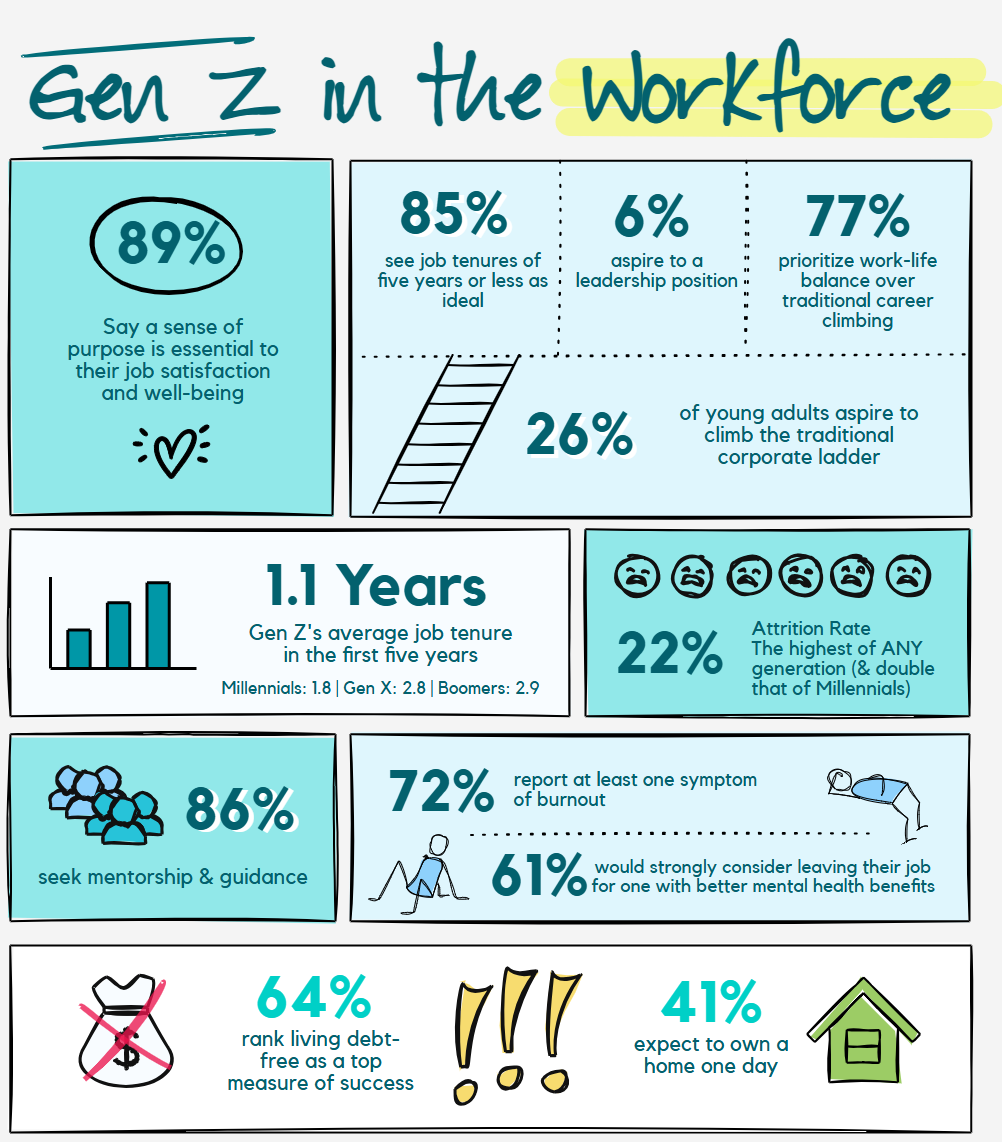
Lily Rancatore: Yeah, 100%. But also, Lucia, had me thinking, it's such a rarity to find, at least for our generation, I think, to stay at a company for more than three years maybe. I think the- That's interesting ... transition that Gen Z's willing to make, again, going back to what I said, if this place doesn't have what I want, let me go find somewhere that does.
And there's a lot less corporate allegiance, I would say. My dad, he's worked for the same company for over 20 years, and he was like, "They've treated me well. I do well here. That's good enough for me." And I think a lot of people feel that way, and Gen Z doesn't. They're like, "I'm gonna find what works best for me, where I feel valued, where I feel treated well, where I'm able to do work that brings me value and excitement."
And I think there's just so much more flexibility across the board when we look at if you were to pull all this data around generations and workforce and turnover and how long folks are staying at organizations, I'd be really interested to see what we found. But I think you would see that Gen Z is much more quick to move on and find something that works better for them.
Dr. Katherine Jeffery: And tell me what you two think of this, 'cause I found some recent research that Gen Z-ers, especially those who graduated college and entered the workforce during COVID they're really looking for stability.
To your point, they're not willing to sacrifice this isn't a good culture for that stability, but they really want that stability.
So Lucia, to your point you found both.
Lucia Valentine: Yeah. I find that with my younger sister. She graduated two years ago now, and all she wanted was just stability. She wanted to know that, the other shoe wasn't gonna drop.
Dr. Katherine Jeffery: Yeah.
Lucia Valentine: She was gonna be able to land somewhere that was just going to work out, and needed that reassurance that it was all going to work out.
Dr. Katherine Jeffery: Yeah.
Lucia Valentine: Yeah. I found it, but I did feel for her, because even though COVID had its impact on me I still had some certainty. I was able to work remotely, For most of that time.
Lily Rancatore: Yeah, I do wonder how much that desire for stability is coming from the Gen Z that's even younger than we are.
So I was a junior in college when COVID hit, and I was pretty much almost finished with my education. I hit the end of my junior year, into my senior year, and then entered the workforce. For me, it was about finding something that I felt passionate and aligned with, but that's what fundamentally I was looking for.
But I can see a lot of folks who started their college career in COVID, and then went through their college years in COVID. Early college years. Those are very fundamentally shaping years of independence, and I think I could see folks who experienced COVID early in their college career wanting that stability.
Saying, "I didn't feel secure throughout my early college years." "That really shaped me. Now I need a job where I know I can show up, I'm gonna do a job, they're gonna be there for me, it's gonna be there tomorrow. I'm not at risk here." And I think there's a lot of comfort in that for folks who were surrounded by that instability when maybe it mattered a little bit more.
Lucia Valentine: Yep. Yeah.
Dr. Katherine Jeffery: Good. Okay. Here's a good question for you two. Can you share with us a moment when you felt proud of your work in HR?
Lucia Valentine: I know mine. Mine was, like, such a win. I had inherited a client who had gone through some rapid changes within their C-suite and their organization, and we were needing to rebuild the value of our services, but also address the elephant in the room that was going on with this client. And I had a Zoom call with them, and I just felt on fire the entire time.
I felt like the new C-suite were so open. I had that partnership. They were ready. I think that is a huge word. They were ready for the conversation. And they were excited about the work and the potential, and I had buy-in. It was a call that I knew during the call, which was so empowering for me.
But I left after it and I was like, "I can't wait to just say this company's ready. They're ready to grow. They're ready to address where they went wrong. We are starting fresh, right? We can't go back, but here's how we can go forward." And I was able to partner with all of my internal partners. So I was able to send them to Lily for organizational development. They really wanted to work on their mission- value statement. They really wanna empower their managers and leaders and do different trainings. They're ready to start their handbook, so they're gonna work with their HR specialists. They're ready to dig into expanding to other states and what those laws mean in those states.
And I felt energized by that conversation, and I feel energized going back into those conversations. I meet with this client biweekly. I love what they do. They've also got me to, get behind what they do, too. Not that I don't with all of my clients, but this client in a special way.
And just really excited to, dig my teeth in with them and see them grow. I told them after that meeting with full certainty, "I cannot wait to celebrate all that's to come in 2027." Because we are gonna look back at this year and not only am I gonna applaud you, but you're gonna feel good about the work that you've done.
And I'm also trying to empower this new C-suite to stay, right?
To not leave. It might be easy to run and it might be hard, but the hard thing that you're doing is gonna be so worth it, and you're here for a reason.
And just building that value. That was just a huge win for me.
They're digging into all of the services that we offer and I've built a relationship and continue to build that relationship. And, that's not one of the clients that's calling me telling me about their kid's dance recital, and that's okay.
It's just as valuable as a client in a relationship even though we're not getting into some of those Gen Z topics, right?
The outside-of-work topics. Value them all the same and that was a really great win for us. I'm excited to see in 2027 where they end up and the growth to come.
Dr. Katherine Jeffery: Awesome.
Lily Rancatore: I'm struggling to pick one 'cause I thankfully feel like I've had some good wins with clients lately.
But there's one that stands out to me, and it's a very Gen Z coded story, so I'll share it. But I was working with this organization helped facilitate some content for them at a leadership retreat. I was working really primarily with the people director at this organization. And she oversaw all of HR all of development. She is a team of one. And we partnered to make this retreat happen. The content went over really well. The leadership team really enjoyed it. And then over the next few months, some other leadership issues came up that she just wanted help navigating, so we engaged into this kind of consultative relationship where we were meeting and just discussing.
And honestly, I just would spend a lot of time listening to her kind of sharing what was going on. Just talking her through how to maybe approach some certain scenarios. Always coming back to the fundamentals of the why in communication, and the small impact that she could make.
But ultimately, I didn't ever feel like this was, like, a huge lift for me from a work perspective, right? I was just listening to her. I was consulting with her. There was no really tangible deliverable that I was giving them. But she said to me after one of our calls "You're like the colleague I've always wanted, but never had."
And it just made me feel all warm and fuzzy inside. And it made me think I'm doing something right. Coming back to the imposter syndrome, I'm always like, "Am I qualified enough to be giving you this recommendation or advising you in this way?" But to just, I think, ultimately be there and to listen to her, and we fostered this sense of trust where she felt like she could open up to me about certain things, and that she could gain some insight from the recommendations I was giving.
And it really just, again, it made me feel valued, which just reinforced that I love what I do, and that I love working with leaders like herself. And it was just a really positive experience. It's things like that, that make me wanna keep showing up every day to this job.
Lucia Valentine: That's awesome.
Dr. Katherine Jeffery: It is awesome. So what feels especially Gen Z about how you two practice HR?
Lucia Valentine: Authenticity?
Lily Rancatore: Yeah. I was gonna say, it's a lot of what we've been saying, right? Showing up as our authentic selves. Explaining the why because that's what we expect in return .Being upfront and transparent, being communicative, being as clear as we can be about expectations and the part that we play in certain projects or discussions versus what we need our clients to do.
Really setting the groundwork as much as possible. Yeah, I think a lot of what we've been saying. What do you think, Luch?
Lucia Valentine: I think authenticity. Also I said it earlier about watching everyone's lives unfold in front of us on the Gram, and I feel like in HR and choosing the roles that we chose we really chose a role that's in line with who we are.
What you see is what you get, and that feels very Gen Z to me.
Lily Rancatore: Yeah.
Lucia Valentine: I'm actually believing in what I'm doing every day. Mm-hmm. And that's pretty special. And I argue that not that it's not a privilege, but it took work to get here, and that's okay. It's okay to advocate for yourself, and it's okay to say no and find where you're best suited, and I think that's Gen Z too.
Like is this where you're best suited? Like, where are your talents gonna be recognized? And if it's not here it's not the end of the world. But what's gonna be best for you? So that feels very Gen Z.
Dr. Katherine Jeffery: Yeah. That's really good. Is there anything that you two wish other generations understood about the Gen Z experience in HR?
Lily Rancatore: I'd say give us a chance to prove you wrong because I think, like we were saying earlier, there's the perception that a lot of time that Gen Z maybe is lazier, things have been handed to them. And I think that you would be surprised how many Gen Z are very career-oriented, who are looking for a challenge, who think in systems, not just people.
We are just two Gen Z out of the entire generation, right? Yeah. And so I think our values ultimately are very representative of the generation, but each individual is different. And also not to define someone by their generation. I think that would go for us too as well upwards, right?
Likewise, yeah. So 100% not defining someone just based on the generation they were born into. I think so many pieces go into it, who they ultimately are and how they perform in the workplace and within HR. But yeah, I would say just give them the chance to prove you wrong. Allow them to be challenged.
Meet them where they are as well. And that goes for Gen Z as well.
Lucia Valentine: Yeah.
Lily Rancatore: Meet other folks where they need to be met and find that common ground.
Lucia Valentine: Yeah. You can't see my big thumbs up on a podcast, but I a massive thumbs up I couldn't agree more here, Lily, and I think that I also would challenge Gen Z-ers who aren't asking for feedback to ask for feedback.
And I think that across generations that is such an empowering tool to use. I'm using it with my clients to build trust. I think as a Gen Z-er and, coming out the gates of just "I want what's best for you. This is gonna be awesome, and we're gonna get all of your HR motives in line," also, this is real life.
Like maybe we aren't jiving. Maybe we need to have some transparent conversations. I have a high EQ, so I'm pretty aware situationally just based off of even how the tonation of people's voices where to meet them where they're at. But I agree with Lily, exactly what you said.
And it's for us too to, like learn from everyone, right? What's the next generation? Who's coming after us? I'm excited for that.
Dr. Katherine Jeffery: Yeah. Alpha.
Lucia Valentine: Alpha, yeah. That's gonna be interesting, and I know even when Lily started, I was like, "oh, you're really" ... 'Cause I'm a zillennial, right?
'97. I was like, "Oh, you're really Gen Z."
Lily Rancatore: I'm in the thick of it.
You really are. I remember feeling like imposter syndrome because I was the token Gen Z-er, 'cause we have proper Millennials. At the time, we had a ton of proper Millennials that were in our office, and they didn't understand us. I remember feeling like, "You guys are not that much older than me." And like, how is there this major disconnect of values?
Lucia Valentine: Wow. I remember just being like, "Ugh." ... I want you to be real with me.
Lily Rancatore: Yes.
Lucia Valentine: It's nothing against our corporation, but it was at corporate, right?
I want you to actually be the human that you are.
And I think that you also have to remind yourself of people's stories, people's generations and all that's coming into play. And there are people, I'm sure, even in our generation that just wanna show up to work and be at work and at home being at home.
Yeah. You're talking to two extroverts.
Lily Rancatore: It's so true. Yeah.
Lucia Valentine: Everyone who's listening, we are. Like I'm sure some people are like, "Ooh. Oh, yep. Here they are." "Here are the extroverts."
Lily Rancatore: It's true, though. We are certainly not representative of the generation by all means. But I think that there is a lot of diversity within values, within needs within a workplace, within upbringings, and that all shapes, obviously that all creates it the generation, and it shapes how we show up to work and what we need from work. But I think across the board it is a lot of what we've said.
It's understanding that we are gonna need to have those difficult conversations. We are gonna need that level of transparency. We are gonna bring our feelings to work. Yep. And I would encourage leaders to encourage their employees to do that, because then that's when you get a really authentic, genuine work environment, and that's when you really start to see the pieces of the puzzle come together.
You start to see people mesh. You start to see relationships building. And I think there's something there that, corporate policy can't create, right? That is ultimately, it comes back down to culture. It comes back down to the environment that you create by encouraging this sense of openness that I think is very innate to Gen Z.
Lucia Valentine: Well said.
Dr. Katherine Jeffery: So good. What's the phrase? Should I say no cap?
Lily Rancatore: Yeah.
Lucia Valentine: That might be Alpha's phrase.
Dr. Katherine Jeffery: I don't even know. No notes.
No notes. That's right. No notes. You already taught me that one. Okay. No notes. No notes. So good. Okay, is there anything the two of you wanna add that you haven't been able to say yet?
Lucia Valentine: I don't know. I feel like Gen Z, nothing left unsaid.
Lily Rancatore: Yeah, it's true. Yeah, I feel like we've covered a lot of ground. I think it's just, it's really great to have this conversation, Katherine and Lucia. Yeah. Being in the same generation, it's not like we've ever talked about this too.
No. But to see how aligned we are as well, this has just been so interesting and so fun, and I wanna continue the conversation. I wanna bring it to the office.
Lucia Valentine: Me too. I feel the exact same. Next Monday, it's gonna be like, "Okay."
Lily Rancatore: We're gonna have a little generational roundtable.
Dr. Katherine Jeffery: Yes. That's right.
Lucia Valentine: Give some people the creepy crawlies, but.
Dr. Katherine Jeffery: Yeah, this has been so fun. I just- Oh, it's been great ... have enjoyed both of you so much. I think all the listeners will enjoy your extrovertedness.
So thank you both so much for taking time out of your day to be part of this.
As we wrap up, every generation enters HR under different conditions. There's different labor markets, different cultural expectations, and different norms, obviously around transparency and trust, which are huge values for Gen Z.
Dr. Katherine Jeffery: Really to summarize the values we're hearing that you all place at the top of the list with Gen Z in general, but then you're bringing this into HR- Is that you're people-centered, right? People matter. That's why we're here. You wanna know the why behind why something's happening and why it's important.
You want the mission and vision and the values to not only resonate with who you are, but then to be actually lived out- ... by not only you, but the people around you. You want there to be a strong sense of development within the organization. You are voracious learners. You wanna keep learning and growing, and I think often Gen Z feels like, "Okay, I'm not growing help me out here."
Rather than being something that we're like, calm down," that's a beautiful thing that we can turn into a huge asset in our organizations. And then I also heard you talk about clarity of expectations. I think that's super important to your generation, and I think everybody cares about that, but older generations maybe didn't always get that, and Gen Z's saying no, I'm gonna ask questions until this makes sense to me
and until I know I'm getting it right," because you do want to get it right. You're trying to actually serve the people you're working with in the best way that you can. And so you wanna understand it. And then obviously, that very strong value of transparency and authenticity and bringing your real self wherever you are, whatever you're doing.
So this is our final episode in the HR Across the Generations series, and if you've listened to all four, you've now heard HR through Boomer, Gen X, Millennial, and Gen Z eyes. I wonder if you've noticed what's shifted and what stayed the same.
Thanks for sharing this space with us. If you've enjoyed this episode, please subscribe, and share it with someone else who might find it meaningful.
Keep building those bridges, because there is solid gold to be found when the generations choose to walk alongside one another. Thank you, Lucia and Lily. It was a pleasure.