The Early Adopters Are Having Second Thoughts
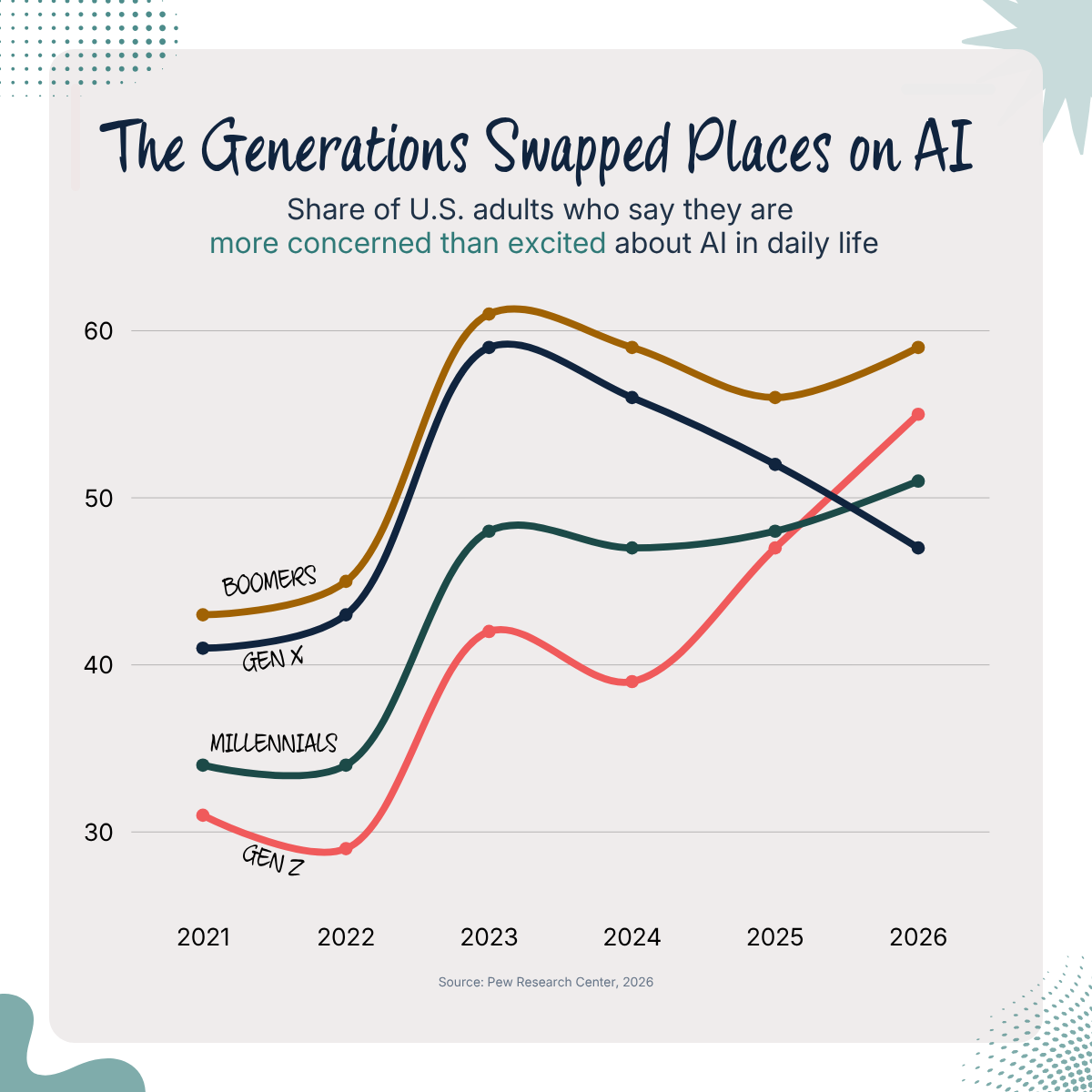
We all know the script. Younger people dive into new technology, older people hold out, and eventually everyone ends up in the same group chat. It’s tidy, and with AI it’s already out of date.
Look at the graphic. In 2021, 31% of U.S. adults ages 18 to 29 told Pew Research Center they were more concerned than excited about AI in daily life. By 2026 that number was 55%, within a few points of the 59% for adults 65 and older. Over the same stretch, the share of 18 to 29 year olds who were more excited than concerned fell from 25% to 11%.
Gallup found a similar pattern with a different yardstick. The share of Gen Z respondents who said AI makes them excited dropped from 36% to 22% in a single year, while daily or weekly use stayed at roughly half. (Gallup surveyed 14 to 29 year olds, so the age range differs from Pew’s.) People are still using it. They just like it less.
Scott Zimmer gave his explanation in our conversation on episodes 25 and 26 of the GenShift Podcast. Here’s what the research says about why that might be happening.
Using something a lot and judging it well are different skills
One of the quieter findings in this research is that familiarity doesn’t buy accuracy. In a study in Computers in Human Behavior, 246 participants used AI to work through logical reasoning problems from the LSAT. They scored about three points better than a norm population, and they overestimated their own score by four. The twist is that participants with higher AI literacy were less accurate at judging how well they had done, not more.
If you’ve used AI every day since college, that’s an uncomfortable mirror. Early enthusiasm may rest partly on a feeling of competence the tool helps produce. The cooling off could be what happens when that feeling meets reality: the confident wrong answer, the repeated paragraph, the manager who asks how you got there.
Why the machine sounds so sure
It’s tempting to treat confident wrong answers as a glitch the next release will fix. Two lines of research suggest it’s more structural than that.
OpenAI researchers argued in 2025 that language models hallucinate in part because standard training and evaluation reward guessing over admitting uncertainty, the way a test taker is better off filling in every bubble. Separately, researchers at Anthropic found that AI assistants trained with human feedback lean toward sycophancy. People, and the preference models trained on their ratings, sometimes preferred a convincingly written, agreeable answer over a correct one.
Put those together and a confident, flattering answer isn’t evidence the system knows something. It’s what the incentives produce. That changes the question for every generation. It’s less “how good is this tool?” and more “what is it rewarded for, and what does that leave me responsible for?” The OpenAI paper’s proposed fix is telling: change the scoring so that appropriate uncertainty earns credit instead of a penalty.
The sameness problem
A 2024 study in Science Advances gave some writers AI-generated story ideas. Their stories were judged more creative, better written, and more enjoyable, especially for writers who started out less creative. But the AI-assisted stories were also more similar to each other. The authors describe it as a social dilemma: each writer is better off, and the group ends up with a narrower range of ideas.
Now set that beside Pew’s 2025 findings. Among adults under 30, 61% said AI will make people worse at thinking creatively, compared with 42% of adults 65 and older. On forming meaningful relationships, it was 58% versus 40%. The generation with the most hands-on experience is more worried about the creative cost, not less. They may be noticing something that less frequent users haven’t had the repetitions to see.
Why the stakes feel different at 24 than at 54
Part of this has little to do with the technology. A Gallup researcher told Axios that Gen Z’s growing anger may be driven by AI dimming prospects for entry-level workers, and that someone mid-career, playing with AI without feeling threatened, may be less acutely aware of its impact. Pew’s numbers fit that reading. Among 18 to 29 year olds, the share expecting AI to mean fewer jobs rose from 61% in 2024 to 73% in 2026. Gallup also found that 69% of Gen Z workers trust work done without AI more than AI-assisted work.
Generation and career stage are tangled together here, and survey data can’t fully pull them apart. A 24-year-old’s skepticism and a 54-year-old’s curiosity could plausibly be responses to the same fact: one of them has far more of a career still ahead to protect.
What the generational lens adds
The GenShift® question is always what shaped someone. Many older adults formed their standards for good work before AI existed, so they have a baseline to compare it against. Many in Gen Z are building those standards with AI already in the room. That makes it matter a great deal whether anyone helps them practice checking.
Of the Three C’s, Collaboration is the one I’d put the most weight on here. The older colleague with the baseline and the younger colleague with the fluency each hold half of what a team needs. Neither generation is the expert on this. Both are working it out in real time.
So the early adopters are updating their views. That isn’t a retreat. It’s what learning looks like once the novelty wears off.
A few questions to sit with:
Where in your own work would you notice a confident wrong answer, and where wouldn’t you?
Who around you has the baseline to catch what you might miss?
Listen to both parts of my conversation with Scott Zimmer on GenShift here. I’d love to have you join the conversation!
Sources
Pew Research Center, concern and excitement about AI: https://www.pewresearch.org/2025/10/15/concern-and-excitement-about-ai/
Pew 2026 age-group figures, via summary: https://aiunderstanding.org/news/pew-survey-71-of-americans-expect-ai-to-reduce-u-s-jobs-over-20-years
Pew 2025 under-30 figures, via coverage: https://decrypt.co/340511/americans-want-ai-benefits-fear-losing-makes-human
Gallup, Walton Family Foundation and GSV, Gen Z AI adoption and skepticism: https://news.gallup.com/poll/708224/gen-adoption-steady-skepticism-climbs.aspx
Axios on the Gallup findings: https://www.axios.com/2026/04/09/ai-gen-z-polling-gallup
Fernandes et al., Computers in Human Behavior: https://doi.org/10.1016/j.chb.2025.108779
Kalai et al., “Why Language Models Hallucinate”: https://arxiv.org/abs/2509.04664
Sharma et al., “Towards Understanding Sycophancy in Language Models” (ICLR 2024): https://arxiv.org/abs/2310.13548
Doshi and Hauser, Science Advances 2024: https://doi.org/10.1126/sciadv.adn5290