Building Trust Across Generations at Work
Your Shift Is Already Someone Else's Default
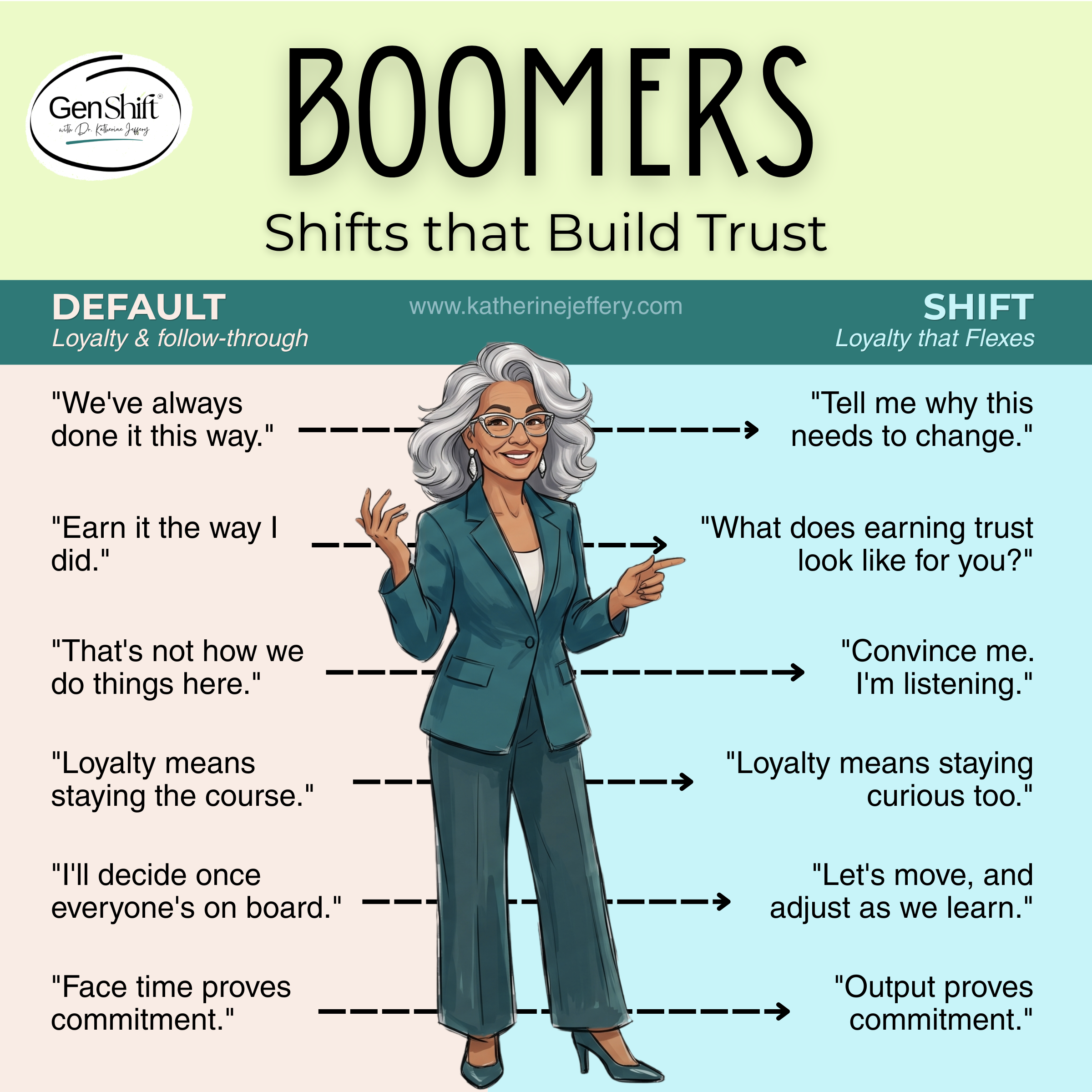
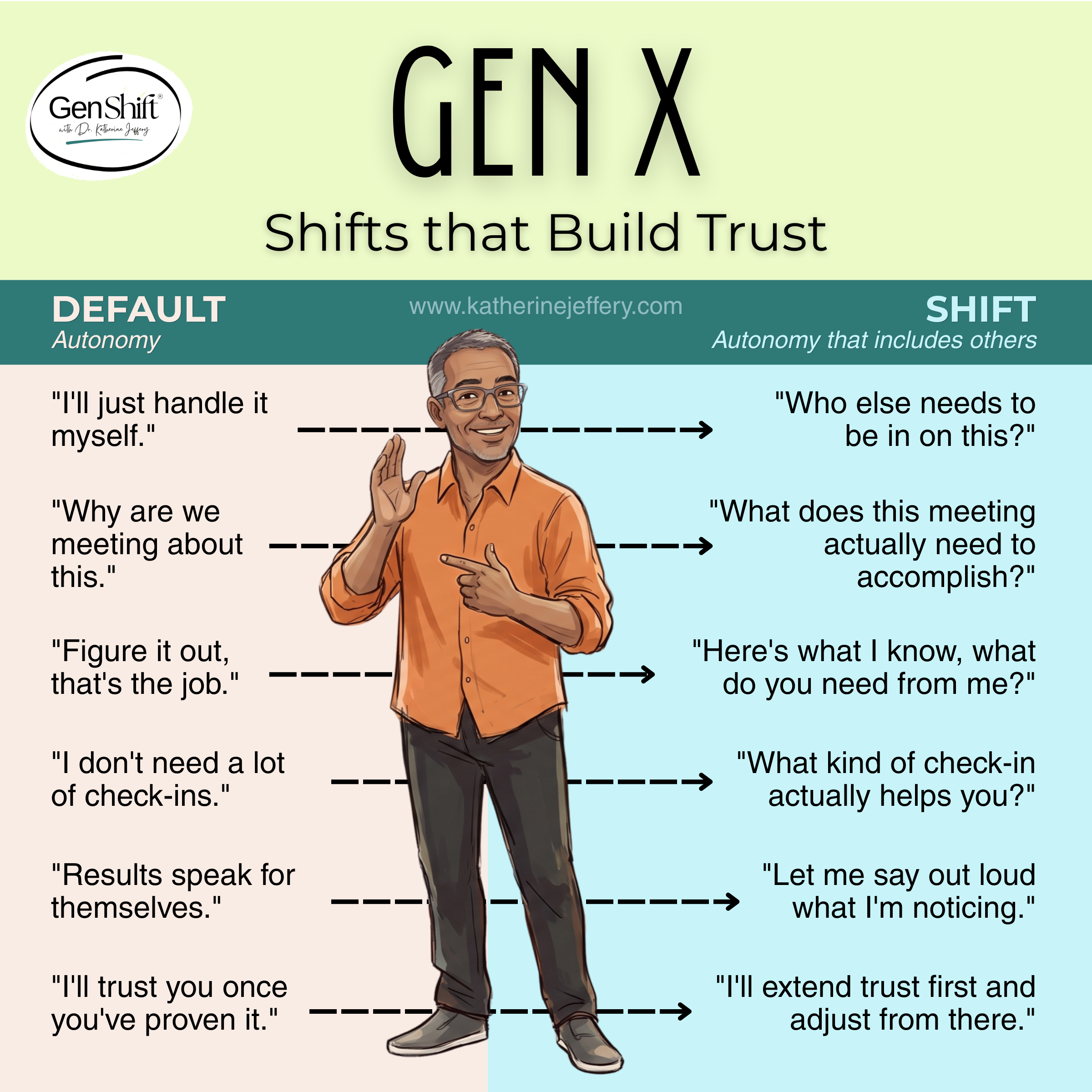
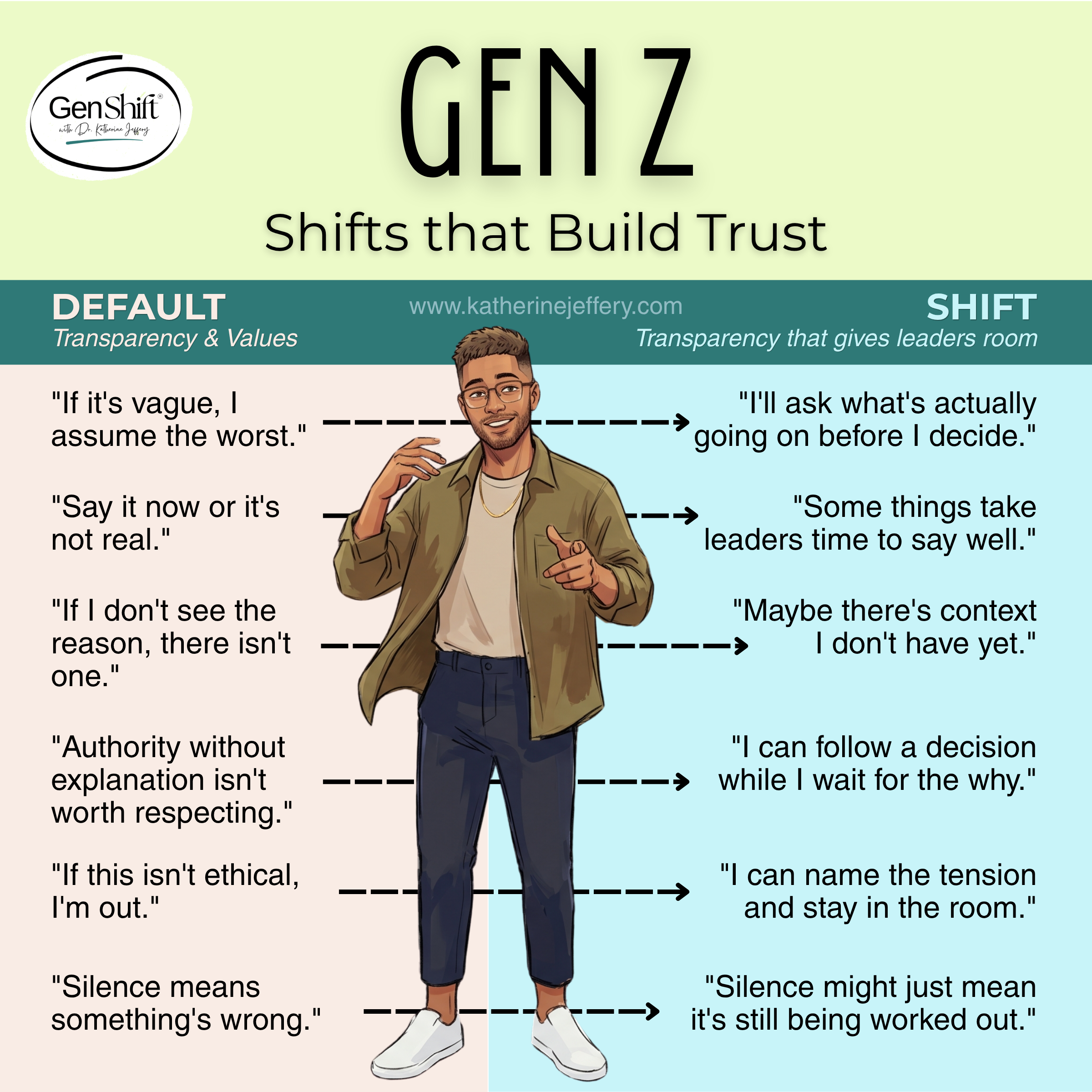
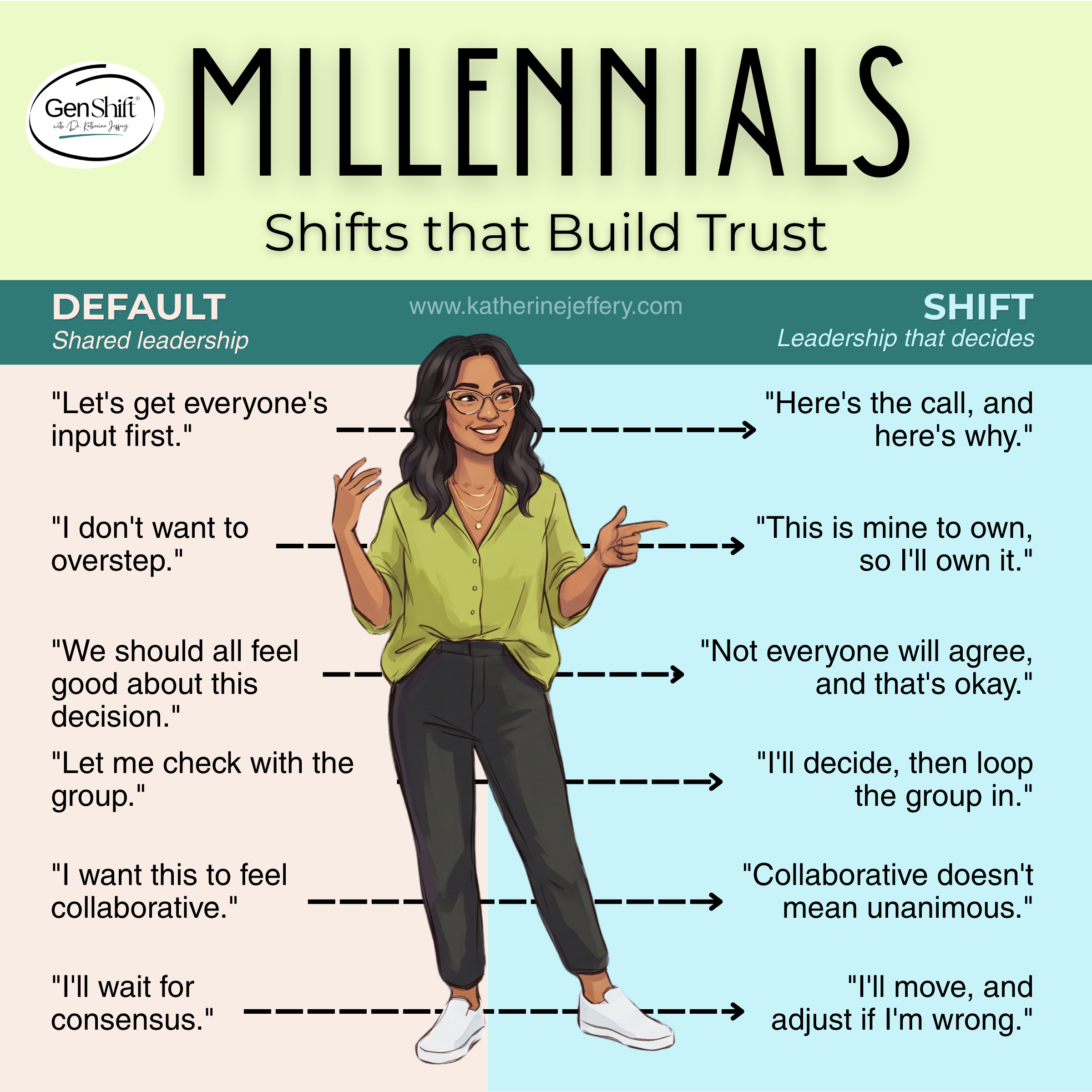
Four generations are sharing the same meeting, and each one walked in with a different definition of what trustworthy behavior looks like. That's most of the friction right there.
If you want the longer conversation on this, the GenShift® Podcast covers generational trust, communication, and leadership in every episode. New listeners usually start there and come back for the GenShift® Field Guide.
Trust isn't in great shape
Gallup tracks this quarterly. As of its most recent reading, only 20% of U.S. employees strongly agree that they trust the leadership of their organization, down from a 24% peak in 2019 and basically flat for four years. That's one in five people who believe the folks running things have their interests in mind.
Same dataset, a number that stings more: only 16% say their company's leadership makes them enthusiastic about the future.
And this is happening in the most age-diverse workforce we've had. Pew Research Center reports that 19% of adults 65 and older are employed today, up from 11% in 1987. People are staying longer. Gen Z is arriving. Nobody's leaving to make room.
So we've got four sets of trust instincts in one building, and a trust problem. Those two facts are related.
The default isn't the flaw
Look at the left column of any of the GenShift® trust graphics and you'll see a list of things that sound like bad behavior.
"We've always done it this way."
"I'll just handle it myself."
"Let me check with the group."
"If it's vague, I assume the worst."
Here's what's easy to miss. Every one of those lines is a trust behavior. It's just aimed at a room that no longer exists.
"We've always done it this way" was how a Boomer proved reliability in an organization where consistency was the whole product. "I'll just handle it myself" was how Gen X proved competence after watching institutions lay off their parents. "Let me check with the group" was how Millennials proved they weren't going to be the jerk in the room. "If it's vague, I assume the worst" was how Gen Z learned to protect themselves in an information environment where opacity usually meant somebody was hiding something.
None of that is dysfunction. It's earned. It's each generation's trust currency, spent in a room where it isn't legal tender anymore.
Here's the part nobody talks about
Read the four graphics side by side and something odd shows up.
The shift each generation needs to make is already another generation's default.
The Boomer shift, "Convince me. I'm listening," is Gen Z's native setting.
The Gen X shift, "Who else needs to be in on this?" is Millennial instinct.
The Millennial shift, "Here's the call, and here's why," is what Boomers and Gen X have been doing for thirty years.
The Gen Z shift, "Some things take leaders time to say well," is Boomer patience, almost word for word.
Read as a set, the shifts form a loop. Everyone is being asked to borrow something the person across the table already does without thinking.
That reframes the whole exercise. This isn't a skills gap. It's a distribution problem. The capability is in the building. It's just concentrated in the wrong people for the moment at hand.
What that means practically
Most organizations respond to generational friction by buying training. Sometimes that's the right call. But if the loop holds, the cheaper move is closer at hand.
If you're a Millennial leader who struggles to make an unpopular call and stand behind it, you don't need a course on decisiveness. You need forty-five minutes with a Gen X colleague who's been making unpopular calls since 2003. If you're a Boomer trying to get better at being persuaded rather than deferred to, watch how a Gen Z teammate handles being challenged. They've been doing it in public since middle school.
The GenShift® framework calls this building Generational Intelligence, or GQ. Not knowing facts about generations. Knowing how to read the room and adjust.
The shift costs you something, and that's the point
The trust graphics look tidy. Left column, arrow, right column. In practice, each shift asks a person to give up the exact behavior that made them credible in the first place.
A Boomer who says "let's move, and adjust as we learn" is trading the thing that built their reputation for prudence. Gen X extending trust before it's proven is dropping the self-protection that got them through three recessions. A Millennial saying "not everyone will agree, and that's okay" is giving up the collaborative identity they were rewarded for their entire early career. Gen Z saying "maybe there's context I don't have yet" is surrendering the vigilance that has, honestly, been right a lot of the time.
That's why these shifts are hard, and why telling people to "just be flexible" doesn't work. You're asking them to spend down their own credibility on the hope that someone else will do the same.
Which is exactly why it has to be reciprocal. A trust shift that only one generation makes isn't a shift. It's a concession.
Three questions that make it real
The GenShift® Curiosity Practice is short on purpose. Notice, Pause, Ask.
Notice. What's my default here, and what room was it built for?
Pause. Is this person's behavior bad judgment, or is it good judgment aimed at a different set of conditions?
Ask. What does earning trust look like for you?
That last one is the whole ballgame. Gallup found that when employees strongly agree their leaders do three things, communicate clearly, inspire confidence in the future, and lead and support change, 95% fully trust their leaders. Every one of those is a communication behavior, not a personality trait. Which is good news, because behaviors are learnable and personalities mostly aren't.
Where to go next
The four trust graphics work best as a team exercise, not a solo read. Put them in front of a mixed-age group, have everyone find themselves in the left column first, and then ask which shift would cost them the most.
That conversation goes places a workshop rarely does.
Interested in more material like this? Check out The GenShift® Field Guide or GenShift Conversation Starters your team can use in the next meeting.
Sources
Gallup, "Indicator: Leadership & Management" (trust in leadership trend, most recent reading May 2026) — https://www.gallup.com/404252/indicator-leadership-management.aspx
Gallup, "Why Trust in Leaders Is Faltering and How to Gain It Back" (the 95% figure) — https://www.gallup.com/workplace/473738/why-trust-leaders-faltering-gain-back.aspx
Pew Research Center, "The Growth of the Older Workforce" — https://www.pewresearch.org/social-trends/2023/12/14/the-growth-of-the-older-workforce/